Leopard Gecko Habitat Setup: Complete Guide (2026)
Complete guide to setting up the perfect leopard gecko habitat including enclosure selection, heating, lighting, substrate, and essential equipment.
Leopard Geckos Reptiles Team
Published
infoDisclosure: This post contains affiliate links. As an Amazon Associate we earn from qualifying purchases, at no extra cost to you.
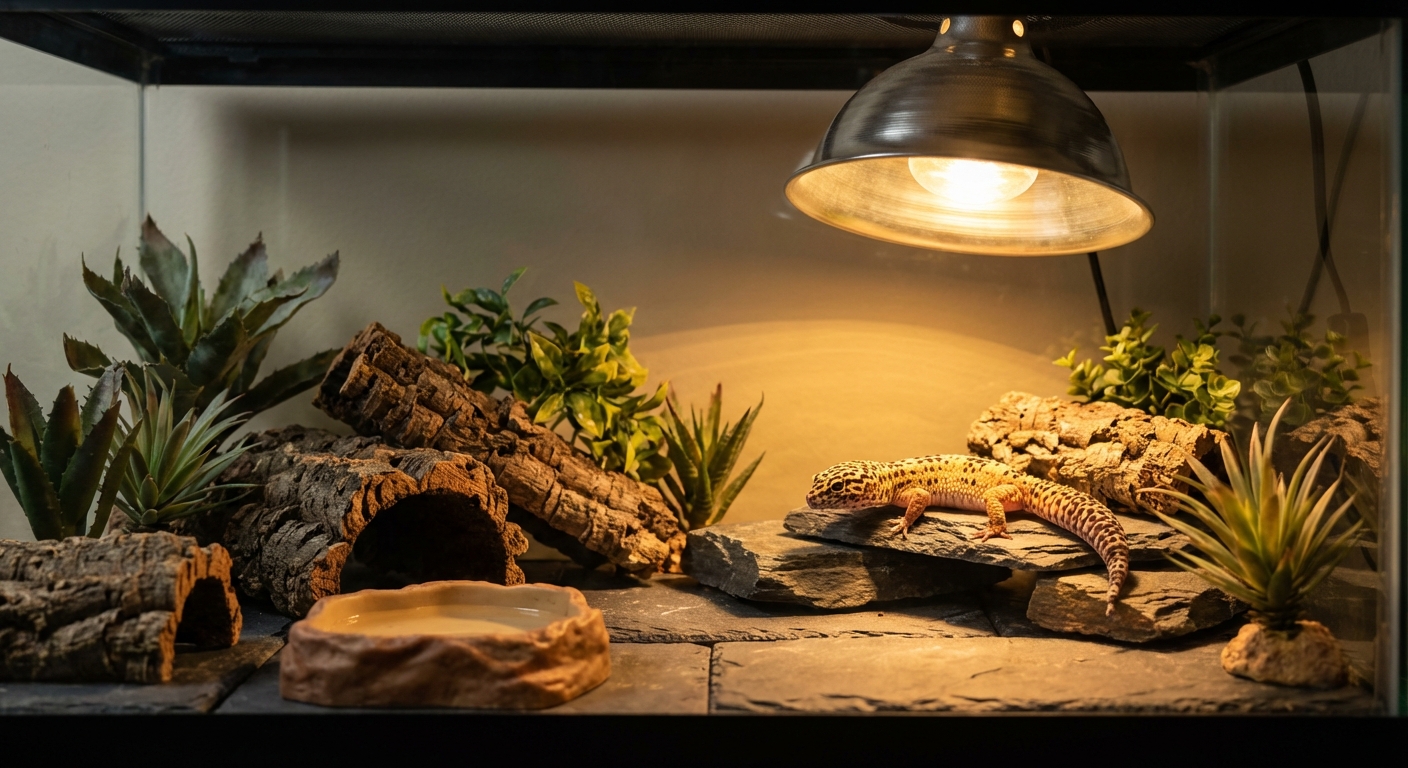
A proper leopard gecko habitat requires a 20-40 gallon enclosure with temperature zones of 88-92°F (31-33°C) on the warm side and 75-80°F (24-27°C) on the cool side. Your setup must include three hides (warm, cool, and humid), appropriate heating equipment with a thermostat, and safe substrate. Creating the right environment from the start prevents health issues and ensures your gecko thrives for its 15-20 year lifespan.
Setting up your first leopard gecko habitat can feel overwhelming with conflicting information online. This comprehensive guide walks you through each component of a proper setup, from choosing the right enclosure size to positioning hides and managing temperatures. We cover both budget-friendly and optimal setups, so you can make informed decisions based on your needs.
infoQuick Setup Checklist
Minimum setup requires: 20-gallon enclosure (40-gallon recommended), under-tank heater or overhead heating with thermostat, three hides, digital thermometers for both sides, safe substrate like slate tile or paper towels, water dish, and calcium dish. Budget approximately $200-300 for a complete beginner setup, or $400-500 for an optimal long-term habitat.
Choosing the Right Enclosure Size
Leopard geckos are ground-dwelling reptiles that need horizontal space more than vertical height. A 20-gallon tank (30x12x12 inches) is the absolute minimum for one adult, but a 40-gallon breeder tank (36x18x12 inches) is strongly recommended. The larger footprint makes it easier to create a proper temperature gradient and gives your gecko room to explore and exercise.
Floor space matters because leopard geckos are terrestrial. They rarely climb and spend most of their time on the ground. Tall enclosures waste space and make temperature regulation more difficult. Look for enclosures that prioritize length and width over height. A 40-gallon breeder offers 50% more floor space than a 20-gallon long, which translates to better temperature zones and enrichment opportunities.
Glass vs PVC Enclosures
PVC enclosures like the Phailozoo 120 Gallon Terrarium are becoming increasingly popular. They provide excellent insulation, are lightweight, and come with features like front-opening sliding doors and top ventilation. PVC enclosures maintain temperatures and humidity better than glass, making them ideal for leopard geckos.
PVC enclosures like the REPTI ZOO 120 Gallon PVC Enclosure offer superior insulation, lighter weight, and better heat retention. They are more energy-efficient and reduce heating costs over time. The main drawbacks are higher upfront cost and the need for assembly. For serious keepers planning long-term, PVC represents the premium option.

Phailozoo 120 Gallon PVC Terrarium (48x24x24)
Spacious 120-gallon PVC enclosure with front-opening doors, excellent ventilation, and stackable design. Perfect for adult leopard geckos who need room to explore.
- check_circleFront-opening sliding doors with handles
- check_circleTop screen ventilation
- check_circlePVC construction for humidity control
lightbulbFront-Opening vs Top-Opening
Front-opening enclosures reduce stress on your gecko. Reaching in from above mimics predator behavior, while front access is less threatening. If using a top-opening tank, approach slowly and let your gecko see your hand before reaching in.
Temperature Zones and Heating Equipment
Proper temperatures are non-negotiable for leopard gecko health. These ectothermic reptiles rely entirely on external heat sources to regulate body temperature, digest food, and maintain immune function. Your enclosure must provide a thermal gradient allowing your gecko to move between warm and cool areas as needed.
Basking Spot (surface)
88-92°F (31-33°C)
Warm Side (ambient)
85-90°F (29-32°C)
Cool Side (ambient)
75-80°F (24-27°C)
Nighttime (all areas)
65-75°F (18-24°C)
Heating Options Compared
Under-tank heaters (UTH) provide belly heat that aids digestion. They work well for leopard geckos and are affordable, but require a thermostat to prevent overheating. Place the UTH under one-third of the enclosure to create the warm side.
Overhead heating like the Arcadia Deep Heat Projector provides more natural heating that penetrates deep into tissue, similar to basking in sunlight. Deep heat projectors emit infrared-A and infrared-B wavelengths without visible light, making them safe for 24/7 use. They create a more natural temperature gradient and allow for better thermoregulation. The 50W version is ideal for 40-gallon enclosures.

Arcadia Deep Heat Projector (50W)
Emits infrared-A and infrared-B for deep tissue heating that mimics natural sunlight.
- check_circleProjects infrared-A and infrared-B heat
- check_circleVirtually no visible light, so it can run day and night
- check_circleStandard screw fitting, sold in 50W and 80W
Many experienced keepers use a combination of both. Overhead heating for ambient temperature and natural thermoregulation, plus a small UTH for supplemental belly heat. This dual approach provides the most naturalistic heating but requires two thermostats or a dual-output unit.
warningCritical: Always Use a Thermostat
Heat mats and heat lamps can reach dangerous temperatures without regulation. A thermostat is not optional; it is essential safety equipment. Unregulated heat sources cause severe burns and can even start fires. Budget $30-150 for a quality thermostat depending on features needed.
Monitoring Temperatures Accurately
Use digital thermometers with probes, not stick-on dial thermometers. You need at least two thermometers: one on the warm side and one on the cool side. Measure surface temperature on the basking spot with an infrared temperature gun for accuracy. Check temperatures daily, as fluctuations in room temperature affect the enclosure.
Do Leopard Geckos Need UVB Lighting?
Leopard geckos are crepuscular, meaning they are most active at dawn and dusk when natural UVB levels are low. They have traditionally been kept without UVB lighting using vitamin D3 supplementation instead. However, recent research suggests that low-level UVB (Ferguson Zone 1-2) provides health benefits including natural vitamin D3 synthesis, improved bone density, and more natural behavior patterns.
The Arcadia ShadeDweller 7% UVB Kit is specifically designed for crepuscular species. It provides appropriate low-level UVB without the risk of over-exposure. If you choose to use UVB lighting, switch to calcium without D3 supplementation to prevent vitamin D3 toxicity. If you skip UVB, use calcium with D3 at every feeding.
Regardless of UVB choice, maintain a natural day/night cycle. Leopard geckos need 10-12 hours of light and 12-14 hours of darkness. Use a timer to automate the light cycle. Avoid bright lights at night; if you need to view your gecko after dark, use a low-wattage red or moonlight bulb sparingly.
infoUVB Decision Guide
Using UVB? Use calcium without D3 + multivitamin. No UVB? Use calcium with D3 + multivitamin. Both approaches work when done correctly. UVB is beneficial but not strictly required if supplementation is proper.
Safe Substrate Options
Substrate choice affects health, maintenance, and aesthetics. The safest options eliminate impaction risk while providing a comfortable surface. Impaction occurs when leopard geckos ingest loose substrate, causing potentially fatal intestinal blockages. Young geckos and those with feeding difficulties are at highest risk.
Safest Substrate Choices
- check_circleSlate Tile: Zero impaction risk, retains heat well, easy to clean, helps wear down nails naturally. Cut to fit your enclosure. Most recommended option.
- check_circleCeramic Tile: Similar benefits to slate. Choose textured, not glossy. Available at hardware stores for $1-3 per tile.
- check_circlePaper Towels: Cheapest option, easy to replace, safe for all ages. Less attractive but functional, especially for quarantine or hospital setups.
- check_circleReptile Carpet: Reusable and safe if maintained properly. Can harbor bacteria in fibers and snag gecko toenails. Wash weekly.
- check_circleTextured Vinyl Flooring: Cut to size, easy to clean, more naturalistic appearance than paper. Ensure no adhesive backing is exposed.
Substrates to Avoid
- check_circleSand (any type): High impaction risk, especially for juveniles. Despite being marketed for leopard geckos, sand causes digestive blockages.
- check_circleCalcium Sand: Still poses impaction risk. The calcium coating does not make it safe.
- check_circleWood Chips/Shavings: Splinters, mold growth, and impaction risk.
- check_circleWalnut Shell: Sharp edges can cause injury. Impaction risk if ingested.
- check_circleAny loose particle substrate for geckos under 12 months old

Reptile Slate Tile (30 x 20 cm)
Natural slate with hand-polished edges and non-slip pads underneath. Zero impaction risk, wipes clean in seconds, and it conducts belly heat from an under-tank heater the way loose substrate cannot.
- check_circleZero impaction risk at any age
- check_circleNatural stone conducts heat from an under-tank heater
- check_circleWipes clean in seconds
Essential Hides and Enrichment
Leopard geckos require three hides minimum: a warm hide on the heated side, a cool hide on the unheated side, and a humid hide for shedding. Hides provide security and reduce stress. A stressed gecko without adequate hiding spots may refuse food, become aggressive, or develop health issues.
The warm hide should be positioned over or near your heat source. Geckos use this hide for thermoregulation and digestion. The Exo Terra Gecko Cave works well for this purpose, offering natural appearance and good heat retention. Ensure the hide is appropriately sized; your gecko should fit comfortably with its body touching the sides for security.
The humid hide is critical for healthy shedding. Fill it with moist sphagnum moss or coconut fiber. The Zoo Med Repti Shelter works excellently as a humid hide because the removable lid makes substrate changes easy. Check the humid hide daily and mist as needed to maintain moisture. A properly maintained humid hide prevents stuck shed, particularly on toes and tail tips.
Additional Enrichment
- check_circleWater Dish: Provide fresh water daily in a shallow, sturdy dish. Place on the cool side to prevent excessive evaporation.
- check_circleCalcium Dish: A small dish of plain calcium powder allows self-regulation of calcium intake.
- check_circleDecorations: Add branches, rocks, or artificial plants for visual barriers and enrichment. Ensure all items are stable and cannot tip.
- check_circleBackground: A background on three sides reduces stress by limiting visual exposure. Use dark paper, cork bark, or commercial backgrounds.

REPTI ZOO Basking Platform with Slate Top
Resin ledge with a natural slate stone top and an enclosed cave underneath. The stone stores heat from an overhead basking bulb and releases it slowly, giving your gecko a warm surface and a dark retreat in one footprint.
- check_circleSlate top stores heat from an overhead basking bulb
- check_circleEnclosed cave underneath doubles as a hide
- check_circleTextured sides for climbing
Common Setup Mistakes to Avoid
1. Inadequate Temperature Regulation
Running heat sources without a thermostat is the most dangerous mistake. Unregulated heat mats reach 120°F+ and cause severe burns. Even if your gecko seems fine, chronic exposure to incorrect temperatures weakens the immune system, impairs digestion, and shortens lifespan. Invest in a quality thermostat before purchasing heating equipment.
2. Using Stick-On Thermometers
Analog stick-on thermometers are notoriously inaccurate, often showing readings 5-10°F off actual temperature. They also measure air temperature rather than surface temperature where your gecko actually sits. Use digital thermometers with probes and an infrared temperature gun for basking spot surface readings.
3. Skipping the Cool Side
Some beginners heat the entire enclosure uniformly. Leopard geckos need a temperature gradient to thermoregulate. Without a cool retreat, your gecko cannot escape excessive heat, leading to stress and dehydration. Heat only one-third to one-half of the enclosure.
4. Overcrowding Decorations
While enrichment is important, overcrowding makes temperature monitoring difficult and reduces usable floor space. Keep the center relatively open, place hides strategically on warm and cool sides, and avoid creating temperature pockets with excessive decor.
5. Using Heat Rocks
Heat rocks are dangerous and outdated. Leopard geckos cannot sense heat from their belly properly and will sit on heat rocks even while burning. These devices have caused countless severe burns requiring veterinary treatment. Never use heat rocks under any circumstances.
warningSetup Before Gecko Arrives
Set up your entire habitat 2-3 days before bringing your gecko home. This allows you to monitor temperatures, adjust thermostats, and ensure everything functions properly. Trying to set up with a gecko already present causes unnecessary stress and rushed decisions.
Frequently Asked Questions
What size tank does a leopard gecko need?expand_more
Can I use a fish tank for a leopard gecko?expand_more
Do I need both a heat mat and a heat lamp?expand_more
How do I know if my temperatures are correct?expand_more
Is sand safe for leopard geckos?expand_more
How often should I clean the habitat?expand_more
Can leopard geckos live together?expand_more
Do leopard geckos need special lighting?expand_more
Creating a Habitat for Long-Term Health
A properly set up leopard gecko habitat is the foundation of good husbandry. By providing appropriate enclosure size, accurate temperature zones, safe substrate, and essential hides, you create an environment where your gecko can thrive for 15-20 years. The initial investment in quality equipment pays dividends through easier maintenance, lower long-term costs, and better health outcomes.
Take time to set up correctly before bringing your gecko home. Monitor temperatures carefully during the stabilization period and make adjustments as needed. Remember that consistent, proper husbandry matters more than expensive equipment. A well-maintained budget setup outperforms a neglected premium setup every time. For specific guidance on temperature management or choosing the best enclosure for your situation, explore our detailed guides on leopard gecko temperature requirements and enclosure reviews.