Best Reptile Thermostats for Leopard Geckos (2026 Guide)
A thermostat is the single most important piece of safety equipment in a leopard gecko setup. Here are the best options for heat mats and overhead heating.
Leopard Geckos Reptiles Team
Published
infoDisclosure: This post contains affiliate links. As an Amazon Associate we earn from qualifying purchases, at no extra cost to you.
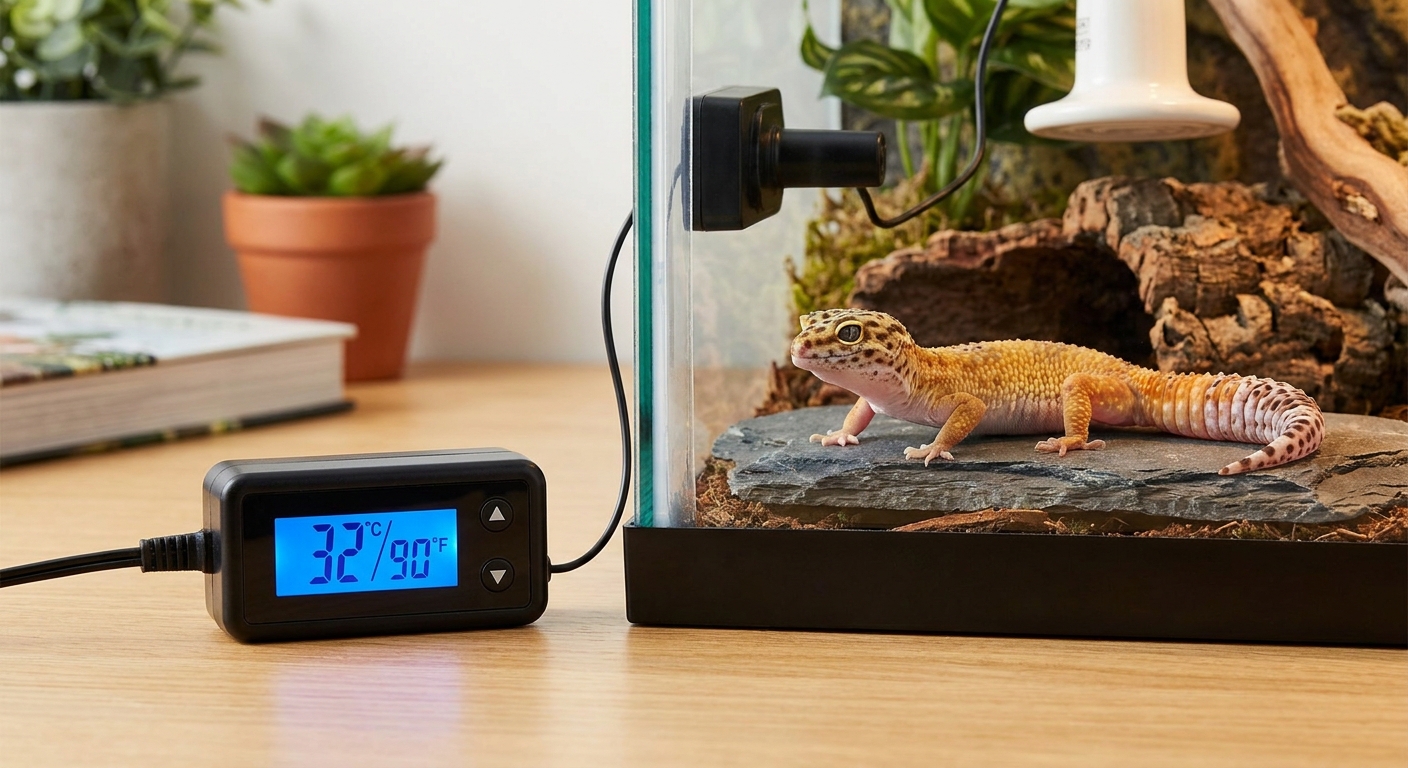
A thermostat is non-negotiable safety equipment for any leopard gecko heat source. Every heat mat, deep heat projector, and halogen bulb should run through one, because unregulated heating equipment can climb well past safe temperatures and cause serious burns. For most keepers, the BN-LINK digital thermostat is the best value pick for controlling a heat mat. It is inexpensive, reliable, and simple to set up. If you use overhead heating such as a deep heat projector or halogen basking bulb, a proportional (dimming) thermostat is the upgrade path, since it adjusts power smoothly instead of switching the element on and off. This guide is based on published manufacturer specifications, husbandry standards from established reptile care resources, and reported experiences from the keeping community.
infoQuick Answer
The BN-LINK digital thermostat is the best budget reptile thermostat for leopard gecko heat mats. Set it to hold the warm side floor at 88-92°F (31-33°C) with the probe placed on the glass above the mat. For overhead heat sources like deep heat projectors, upgrade to a proportional dimming thermostat, which extends bulb lifespan and holds steadier temperatures.
Why Does Every Heat Source Need a Thermostat?
Heating equipment sold for reptiles is not self-regulating. An unregulated heat mat can exceed 110°F (43°C) at the surface, far above anything a leopard gecko should ever touch. Burns in leopard geckos typically occur when surface contact stays above roughly 95°F (35°C) for extended periods, and belly burns from unregulated mats remain one of the most common preventable injuries reptile veterinarians see.
The risk is made worse by how leopard geckos sense heat. They absorb warmth through their bellies and do not always move away from a surface that is slowly overheating, especially while sleeping in a warm hide. A gecko can sit on a dangerously hot spot long enough to blister before it reacts. The thermostat, not the animal, has to be the safety mechanism.
Overheating also affects the whole enclosure. A leopard gecko relies on a temperature gradient, with a warm side around 88-92°F (31-33°C) and a cool side around 70-77°F (21-25°C), to regulate its body temperature. An uncontrolled heat source can push the entire enclosure too warm during summer or when your home heating runs, leaving the gecko no safe retreat. A thermostat costs a fraction of a single vet visit and removes both risks. If you are still planning your heating layout, our leopard gecko heating guide covers the full picture.
Best Value for Heat Mats: BN-LINK Digital Thermostat

BN-LINK Digital Heat Mat Thermostat
Simple on/off probe thermostat that keeps heat mats in the safe range. An inexpensive safeguard every heat source needs.
- check_circleDigital display with day and night settings
- check_circle40-108°F (4-42°C) control range
- check_circleRemote probe sensor
The BN-LINK digital thermostat is the standard recommendation for keepers running a heat mat, and for good reason. It is an on/off style controller with a clear digital display, a simple up/down set point, and a temperature probe on a long cord. It handles the modest wattage of an under-tank heater with plenty of headroom, and it typically costs around $15-25, which makes it one of the cheapest pieces of genuine safety equipment you can buy for a reptile.
Setup takes about five minutes. Plug the heat mat into the thermostat outlet, plug the thermostat into the wall, and route the probe into the enclosure. Place the probe flat on the glass directly above the heat mat, inside the enclosure and underneath the substrate or hide in that spot. This is the exact surface your gecko's belly will rest on, so it is the temperature that matters. Set the target to 88-92°F (31-33°C) and let the system cycle for a few hours before adding your gecko.
After the initial settling period, verify the reading with a separate digital thermometer or an infrared temp gun. If the independent reading disagrees with the thermostat display by more than a couple of degrees, adjust the set point to match reality rather than the display. The main limitations of the BN-LINK are those of any on/off unit: it switches power fully on and fully off, which is fine for a heat mat but not ideal for light-emitting or filament-based heat sources.
On/Off vs Proportional Thermostats: What Is the Difference?
An on/off thermostat works like a light switch. When the probe reads below the set point, it sends full power to the heat source. When the probe passes the set point, it cuts power completely. The result is a gentle sawtooth pattern where the temperature drifts a degree or two around your target. For a heat mat warming a slab of glass and substrate, this is completely acceptable. The thermal mass smooths out the swings, and the mat does not care how many times it is switched.
A proportional thermostat, also called a dimming thermostat, works like a dimmer switch. Instead of cycling full power on and off, it continuously varies the output, feeding the heat source just enough electricity to hold the probe at the set point. Temperatures stay steadier, often within a fraction of a degree, and the heat source runs at partial power most of the time.
The distinction matters most for overhead heating. Deep heat projectors and halogen bulbs use filaments or ceramic elements that suffer from constant hard switching. On an on/off thermostat, a halogen visibly flickers on and off, which can stress the animal and looks unnatural, and the repeated cold starts shorten bulb lifespan significantly. A proportional thermostat avoids the flicker entirely and lets filament-based bulbs last far longer. If you run any light-emitting or projector-style heat source, treat a dimming thermostat as a requirement, not a luxury.
On the premium end, Herpstat and Vivarium Electronics are the two proportional brands most trusted in the hobby. Both offer models with multiple outlets, day and night set points, safety shutoff features, and alarm functions. They cost several times more than a basic on/off unit, but for a multi-enclosure setup or an expensive overhead heating rig, the precision and safety features justify the price. For a single leopard gecko on a heat mat, they are more than you need.
What Heat Sources Should You Pair With Your Thermostat?
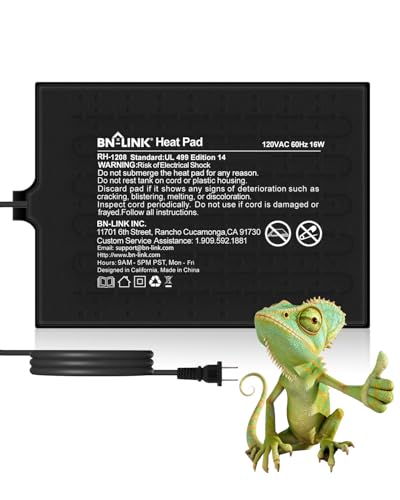
BN-LINK Reptile Heat Pad (8 x 12 in, 16W)
Adhesive under-tank heat pad from the same maker as the BN-LINK thermostat. It provides the belly heat leopard geckos use for digestion and draws only 16 watts, so it must run on a thermostat rather than straight from the wall.
- check_circle8 x 12 inch pad, 16 watts, 120 volts
- check_circleAdhesive back sticks to the underside of a glass tank
- check_circleWater-resistant surface wipes clean
The classic leopard gecko heating combo is an under-tank heat mat controlled by an on/off thermostat like the BN-LINK. BN-LINK also makes a 16 watt, 8 x 12 inch heat pad, and that low wattage sits comfortably within the switching capacity of any budget thermostat. Stick the mat under one third of the enclosure floor, on the warm side only, so the gecko always has a cooler area to retreat to. Never run the mat without the thermostat, even for a quick test, because an unregulated mat can pass safe temperatures within an hour.

Arcadia Deep Heat Projector (50W)
Emits infrared-A and infrared-B for deep tissue heating that mimics natural sunlight.
- check_circleProjects infrared-A and infrared-B heat
- check_circleVirtually no visible light, so it can run day and night
- check_circleStandard screw fitting, sold in 50W and 80W
If you heat from above, the Arcadia deep heat projector is a popular choice because it produces infrared wavelengths that penetrate deeper than a standard ceramic heater. This is exactly the kind of element that needs a proportional thermostat. On an on/off unit, the projector's element endures constant full-power cycling, which wastes its lifespan and produces noticeable temperature swings at the basking surface. Pair it with a dimming controller, mount it above the warm side, and aim for a basking surface of 88-92°F (31-33°C) measured with an infrared temp gun. Our guide to the best heat lamps for leopard geckos compares overhead options in more detail.
How Do You Place the Thermostat Probe Correctly?
Probe placement is where most thermostat setups go wrong. The thermostat only controls the temperature at the probe, so a probe in the wrong spot gives you confident, precise control of a temperature that does not matter. Follow these steps for a heat mat setup.
- check_circleRoute the probe into the enclosure, not taped to the outside glass. Outside readings run several degrees cooler than the surface your gecko touches.
- check_circlePlace the probe flat on the inside floor directly above the center of the heat mat, where the surface runs hottest.
- check_circleSecure it lightly so the gecko cannot drag it away. A small dab of aquarium-safe silicone or a flat rock resting beside it works well.
- check_circleKeep only a thin layer of substrate over the probe, matching what covers the rest of the warm side, so it reads the same surface your gecko rests on.
- check_circleSet the target to 88-92°F (31-33°C) and allow two to three hours for temperatures to stabilize.
- check_circleVerify with an infrared temp gun on the actual basking surface, then fine-tune the set point until the surface reading is correct.
For overhead heating, the same logic applies with one change: place the probe at the basking surface under the lamp, not high on a wall or dangling in the air. Air temperature and surface temperature can differ by 10°F (6°C) or more under a focused heat source, and the surface is what your gecko lies on. Recheck placement after any rearranging of hides or decor, since a shifted probe silently changes what the thermostat is controlling.
warningNever Run Heat Unregulated
Never run any heat source without a thermostat, even briefly. Thermostats are electronics and they can fail, so verify yours monthly with a separate digital thermometer or an infrared temp gun. If the independent reading and the thermostat disagree by more than 2-3°F (1-2°C), recalibrate or replace the unit. A stuck relay that fails in the on position turns a safe heat mat into a burn hazard.
Frequently Asked Questions
Do I really need a thermostat for a low-wattage heat mat?expand_more
What temperature should I set my leopard gecko thermostat to?expand_more
Can I use one thermostat for two heat sources?expand_more
Why does my halogen bulb flicker on a thermostat?expand_more
Where should the thermostat probe go for a heat mat?expand_more
Are premium thermostats like Herpstat worth it for one leopard gecko?expand_more
The bottom line: buy the thermostat before you buy the heat source, and never plug in one without the other. For a standard leopard gecko setup with a heat mat, the BN-LINK digital thermostat paired with a low-wattage under-tank heat mat is a proven, affordable combination that holds the warm side at a safe 88-92°F (31-33°C). If you move to overhead heating with a deep heat projector or halogen, budget for a proportional dimming thermostat at the same time, since smooth power control protects both the bulb and your gecko. Whichever controller you choose, verify it monthly with an independent thermometer, keep the probe on the surface your gecko actually touches, and you will have removed the single biggest equipment risk in leopard gecko keeping.