Best Heat Lamp for Leopard Geckos: Bulb Types, Wattage and Setup
Which heat lamp a leopard gecko needs, how DHP, halogen and ceramic emitters compare, what wattage to buy, and how to run it safely day and night.
Leopard Geckos Reptiles Team
Published · Last updated
infoDisclosure: This post contains affiliate links. As an Amazon Associate we earn from qualifying purchases, at no extra cost to you.
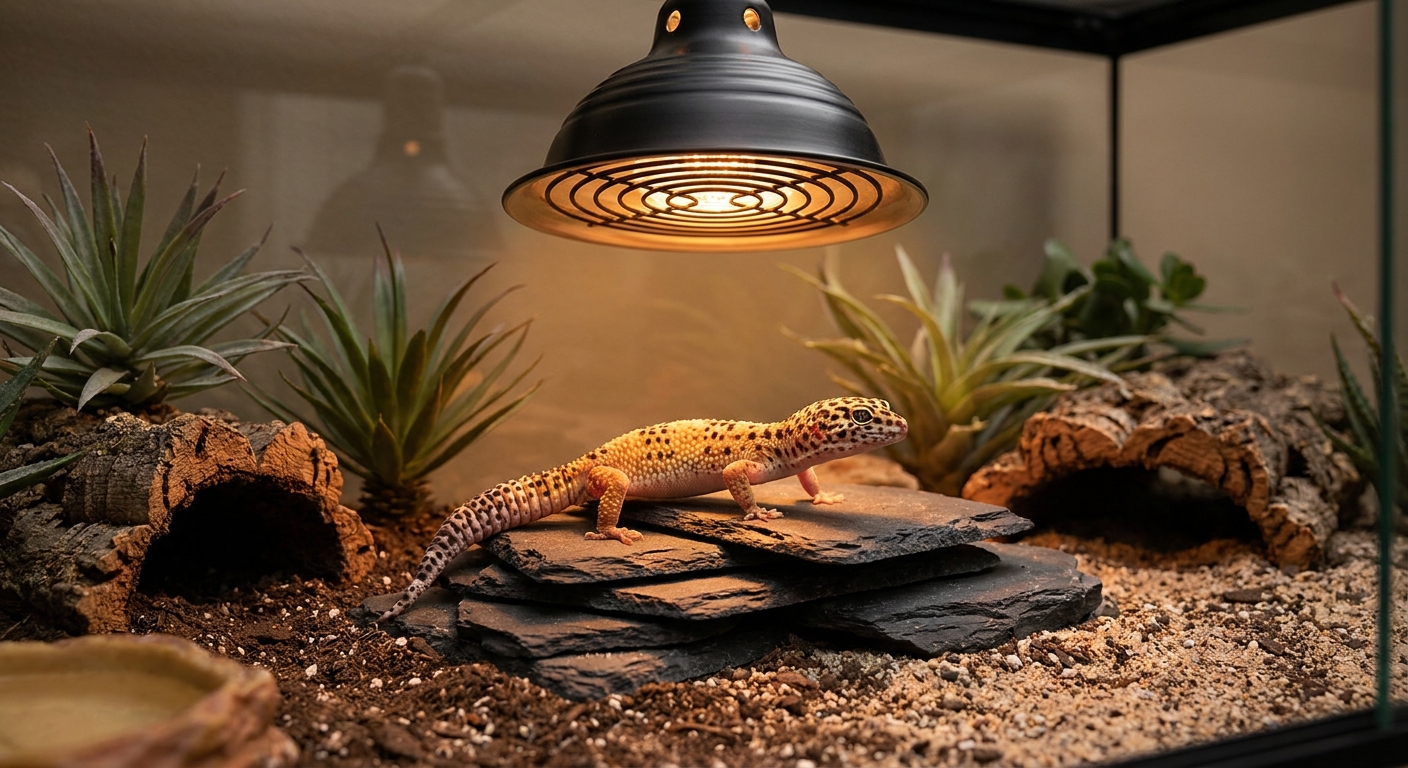
The best heat lamp for a leopard gecko is a halogen flood bulb or a deep heat projector (DHP), run through a dimming thermostat. In a 20 to 40 gallon enclosure, a 50W deep heat projector or a 35-50W halogen is usually enough to hold the basking surface at 88-92°F (31-33°C). A halogen gives off bright light, so it runs during the day only. A DHP gives off almost no visible light, so it can also supply night heat in a cold room.
infoQuick Answer
Best overall: Arcadia Deep Heat Projector 50W, for basking heat that does not disturb the day and night cycle. Best halogen basking bulb: Arcadia Halogen Heat Lamp 35W. Control either one with a dimming thermostat such as the Exo Terra Dimming and Pulse Proportional Thermostat, and check the basking surface with an infrared temp gun. Turn off any bulb that gives off light at night.
Do Leopard Geckos Need a Heat Lamp?
Leopard geckos need a heat source and a warm-to-cool gradient, because they warm up from their surroundings rather than making their own body heat. An overhead heat lamp is the best single heat source. It warms the air, the basking surface, and the gecko itself, which mirrors how sun-warmed rock heats them in the dry grasslands of Afghanistan, Pakistan, and northwest India where the species comes from.
A heat mat can work on its own in a room that stays above about 68°F (20°C), but it only warms the surface it sits under and barely changes the air temperature. In a cooler room, or in a PVC enclosure where a mat cannot heat through the floor, you need an overhead lamp. Whatever you use, it goes on a thermostat, and it sits over one end of the enclosure only so the other end stays cool.
Leopard Gecko Heat Lamp Types Compared
Reptile heat lamps differ in three ways that matter for a leopard gecko: whether they give off visible light (which decides if they can run at night), which kind of infrared they put out, and which type of thermostat they need. The table below sums up the common options.
| Heat source | Light output | Main infrared (IR) | Thermostat | Start at (20-40 gal) |
|---|---|---|---|---|
| Deep heat projector (DHP) | Almost none: day, and night in a cold room | IR-A and IR-B | Dimming | 50W (80W for a taller enclosure) |
| Halogen flood bulb | Bright: day only | Mostly IR-A | Dimming | 35-50W |
| Ceramic heat emitter (CHE) | None: night top-up in a cold room | Longer-wave IR-C | Pulse proportional | Smallest size that holds 65°F |
| Household incandescent bulb | Yes: day only | Less IR-A than a halogen | Dimming | Not recommended |
| Red or blue "night" bulb | Colored light: not recommended | Varies | n/a | Not recommended |
| Heat mat (not a lamp) | None: day and night | Contact heat | On/off or pulse proportional | About 1/3 of the floor |
What Wattage Heat Lamp Does a Leopard Gecko Need?
For most 20 to 40 gallon enclosures, start with a 50W deep heat projector or a 35-50W halogen. Distance matters as much as wattage. Arcadia publishes how hot its Deep Heat Projector gets at set distances below the bulb, and those figures show why the 50W version suits a standard leopard gecko enclosure: the 88-92°F (31-33°C) basking target falls between about 12 and 16 inches below a 50W bulb.
| Distance below the bulb | 50W Deep Heat Projector | 80W Deep Heat Projector |
|---|---|---|
| 6 in (15 cm) | 131°F (55°C) | 144°F (62°C) |
| 8 in (20 cm) | 113°F (45°C) | 124°F (51°C) |
| 12 in (30 cm) | 97°F (36°C) | 111°F (44°C) |
| 16 in (40 cm) | 84°F (29°C) | 97°F (36°C) |
A higher wattage is not automatically too much. On a dimming thermostat, a 75W or 100W bulb runs at reduced power, which is why keepers of larger 4 x 2 x 2 foot enclosures often use them. The risk comes from a strong bulb with no thermostat, or on an on/off controller, in a small tank: it can push the basking spot well past 95°F (35°C) and leave no cool retreat. In a 20 gallon tank, stay at the low end and raise the fixture or lower the thermostat set point if the basking surface reads high.
Best Overall: Arcadia Deep Heat Projector 50W

Arcadia Deep Heat Projector (50W)
Emits infrared-A and infrared-B for deep tissue heating that mimics natural sunlight.
- check_circleProjects infrared-A and infrared-B heat
- check_circleVirtually no visible light, so it can run day and night
- check_circleStandard screw fitting, sold in 50W and 80W
Arcadia describes the Deep Heat Projector as projecting infrared-A and infrared-B with virtually no visible light. Those shorter infrared wavelengths warm deeper than the infrared-C from ceramic emitters and heat mats, which is closer to how sunlight warms a basking animal. Because it gives off almost no light, Arcadia says it can run through the day and night without upsetting the day and night cycle. That makes it the most flexible single heat lamp for a leopard gecko.
It comes in 50W and 80W versions with a standard screw fitting. Use a ceramic socket fixture or mount it inside the enclosure ceiling with a lamp guard so your gecko cannot touch it, and place it over one end of the enclosure above a flat basking stone or slate. Arcadia recommends a dimming thermostat for accurate control, and recommends checking temperatures with a non-contact thermometer.
Best Halogen Basking Bulb: Arcadia Halogen Heat Lamp 35W

Arcadia Halogen Heat Lamp (35W)
A focused-beam halogen basking bulb that puts out mostly infrared-A heat. It gives off visible light, so it runs on a daytime schedule and switches off at night.
- check_circleMostly infrared-A heat in a focused beam
- check_circleFully dimmable on a dimming thermostat
- check_circleStandard E26 screw base
A halogen flood bulb is the other strong choice, and many keepers prefer it for daytime basking because it combines heat with bright light, the way the sun does. Arcadia says its halogen heat lamps put out mostly infrared-A and are fully dimmable on a quality dimming thermostat. The 35W size suits a 20 to 40 gallon enclosure, and the same range also comes in 50W, 75W and 100W for larger or taller enclosures.
The trade-off is the light. A halogen has to go off at night, on a timer set to the same 10-12 hour day you use for any other lighting, so it cannot be your night heat. Pair it with a dimming thermostat. An on/off thermostat flicks the bulb fully on and off all day, which makes the basking spot swing in temperature and shortens bulb life.
Best Thermostat for a Heat Lamp: Exo Terra Dimming Thermostat
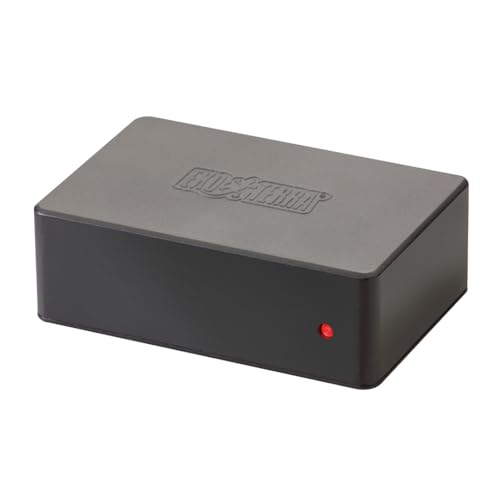
Exo Terra Dimming and Pulse Proportional Thermostat
A two-mode thermostat: dimming for heat bulbs, pulse proportional for ceramic emitters and heat mats. It adjusts power gradually instead of switching a bulb fully on and off.
- check_circleDimming and pulse proportional modes
- check_circleControls 64-100°F (18-38°C)
- check_circleHandles heating devices up to 300W
Every heat lamp needs a thermostat, and this Exo Terra unit has two modes: dimming, for heat bulbs such as halogens and deep heat projectors, and pulse proportional, for ceramic heat emitters and heat mats. It controls from 64-100°F (18-38°C), handles heating devices up to 300W, and uses a waterproof remote probe. The dial has no digital readout, so set it, then confirm the basking surface with an infrared temp gun.
Put the probe where your gecko receives the heat: just above the basking surface for an overhead lamp, out of the direct beam so it is not reading the bulb itself. A basic on/off model such as the BN-LINK digital thermostat is fine for a heat mat, but it is the wrong match for a halogen or a deep heat projector. Our reptile thermostat guide compares the options in more detail.
Deep Heat Projector vs Halogen vs Ceramic Heat Emitter
Choose a halogen if you want a bright daytime basking spot and are happy to run it on a timer. Choose a deep heat projector if you want one lamp that can stay on around the clock in a cold room, or if you already run a separate light such as a UVB tube and do not want a second bright bulb. Many keepers use both: a halogen on a 10-12 hour day schedule, and a DHP on its own thermostat set to the night minimum.
A ceramic heat emitter, or CHE, produces heat with no light at all, so it also works at night. It puts out mainly longer-wave infrared (infrared-C), which warms air and surfaces but warms the animal less efficiently than a DHP. Ceramic emitters run very hot, so they need a ceramic socket, a lamp guard, and a pulse proportional thermostat. For a leopard gecko, a CHE is best treated as night backup in a cold room rather than the main basking heat.
Should a Leopard Gecko Heat Lamp Be On All Day and Night?
Run a light-emitting heat lamp, such as a halogen, for 10-12 hours a day and turn it off at night. Leopard geckos need a dark night and a natural temperature drop, and the night drop to 65-70°F (18-21°C) is healthy. If your room stays above 65°F (18°C) overnight, you do not need any night heat at all.
If the room falls below 65°F (18°C) at night, add heat that gives off no light: a deep heat projector or ceramic heat emitter on a thermostat set to around 65-70°F (18-21°C), or a heat mat on a thermostat. Do not use red or blue "night" bulbs. They give off visible light and disturb the day and night cycle. Our article on whether leopard geckos need heat at night covers night setups in more detail.
How Cold Is Too Cold for a Leopard Gecko at Night?
Below 65°F (18°C) is too cold for a leopard gecko overnight. Cooler nights slow digestion of the evening meal, and a gecko kept cold for long stretches tends to eat less and become less active. Check the cool side with a digital thermometer at the coldest point of the night, usually just before dawn, during the first cold weeks of the year. For the full day and night temperature chart, see our leopard gecko temperature guide.
Heat Lamp vs Heat Mat: Which Should You Choose?
Choose an overhead heat lamp if you can only pick one heat source. A heat mat warms only the surface it sits under, so it cannot raise air temperature in a cool room. The two work well together, though, and many experienced keepers run both, each on its own thermostat. Here is how they compare.
- check_circleAir temperature: a heat lamp raises the warm side air to 80-85°F (27-29°C); a heat mat barely changes air temperature
- check_circleSurface heat: both can hold a basking surface at 88-92°F (31-33°C) on a thermostat
- check_circlePower draw: heat mats use roughly 10-25 watts; most heat lamps use 35-100 watts at full power, and less on a dimmer
- check_circleBehavior: overhead heat encourages open basking; belly heat suits a gecko that digests in its warm hide
- check_circleCold rooms: below about 68°F (20°C), you generally need an overhead source
- check_circleEnclosure type: a mat heats through glass; in a PVC enclosure, use an overhead lamp
How Do You Set Up a Heat Lamp Safely?
- check_circle1. Pick the lamp: a deep heat projector or halogen for basking heat, sized from the wattage table above.
- check_circle2. Buy the thermostat with the lamp. A dimming thermostat for a halogen or DHP, pulse proportional for a ceramic heat emitter.
- check_circle3. Use a ceramic socket fixture or a lamp guard so your gecko cannot touch the bulb, and keep the fixture clear of anything flammable.
- check_circle4. Place the lamp over one end of the enclosure only, so the far end stays a cool retreat at 70-77°F (21-25°C).
- check_circle5. Put a flat stone or slate under the lamp as the basking surface, and the thermostat probe just above it, out of the direct beam.
- check_circle6. Set the thermostat so the basking surface reads 88-92°F (31-33°C) on an infrared temp gun at gecko level.
- check_circle7. Put a digital thermometer probe on each side, check daily for the first week, and recheck when the seasons change.
warningNever Use Heat Rocks, Never Skip the Thermostat
Heat rocks are unsafe for leopard geckos. They develop uneven hot spots that cause belly burns, because geckos do not reliably move off a surface that is slowly getting too hot. Never run any heat source, lamp, mat, or ceramic emitter, without a thermostat. An unregulated lamp can overheat a whole enclosure in hours. If your leopard gecko does suffer a burn, consult a reptile veterinarian.
Basking surface
88-92°F (31-33°C)
Warm side air
80-85°F (27-29°C)
Cool side
70-77°F (21-25°C)
Night (whole tank)
65-75°F (18-24°C)
Frequently Asked Questions
What wattage heat lamp does a leopard gecko need?expand_more
Is a 75 or 100 watt heat lamp too much for a leopard gecko?expand_more
Do leopard geckos need a heat lamp at night?expand_more
Do you need a thermostat for a deep heat projector?expand_more
Do deep heat projectors use a lot of electricity?expand_more
Is a heat mat or heat lamp better for a leopard gecko?expand_more
Can I use a regular household bulb to heat a leopard gecko tank?expand_more
How hot is too hot for a leopard gecko?expand_more
Final Verdict: The Best Heat Lamp for Your Leopard Gecko
For most keepers, the best heat lamp for a leopard gecko is the Arcadia Deep Heat Projector 50W on a dimming thermostat. It gives deep infrared warmth, holds a basking surface at 88-92°F (31-33°C) in a standard enclosure, and gives off so little light that it can also cover cold nights. If you prefer a bright basking spot, the Arcadia Halogen Heat Lamp 35W on a dimming thermostat is the strong alternative for daytime use. Whichever you choose, buy the thermostat with the lamp, verify temperatures with a temp gun, and keep a full warm-to-cool gradient. For hides, food and the rest of the setup, see our leopard gecko care guide.