Do Leopard Geckos Need a Heat Lamp at Night?
Leopard geckos need darkness at night, not light. Supplemental night heat is only necessary if the room falls below 65°F (18°C). Here is how to do it safely.
Leopard Geckos Reptiles Team
Published
infoDisclosure: This post contains affiliate links. As an Amazon Associate we earn from qualifying purchases, at no extra cost to you.
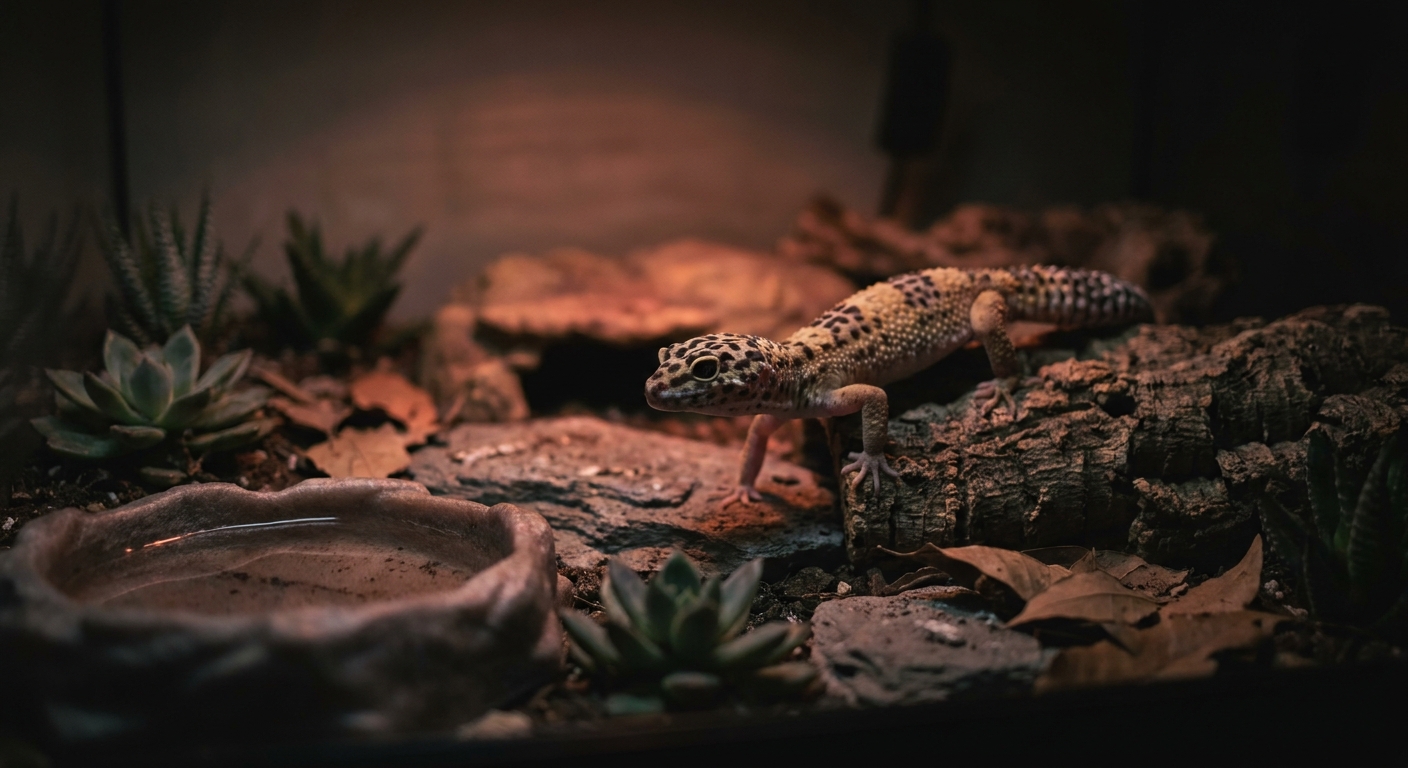
No, leopard geckos do not need a heat lamp at night, and they should not have any light-emitting bulb on after dark. They need supplemental night heat only if the room drops below 65°F (18°C). A natural night drop to 65-70°F (18-21°C) is healthy and mirrors the cool desert nights of their native range.
infoQuick Answer
Turn all lights off at night, every night. If your room stays at 65°F (18°C) or above, your leopard gecko needs no night heat at all. If it falls below that, add a no-light heat source such as a deep heat projector, ceramic heat emitter, or heat mat, always controlled by a thermostat.
The Complete Answer
Leopard geckos are crepuscular, meaning they are most active at dusk and dawn, and they rely on a clear day-night cycle to regulate hormones, appetite, and activity. Any visible light at night, including so-called night bulbs, interferes with that cycle. Darkness is not a gap in their care; it is part of their care.
Heat is a separate question from light. Wild leopard geckos experience warm days and much cooler nights, and captive geckos benefit from the same rhythm. Aim for a warm-side surface of 88-92°F (31-33°C) during the day, then let the whole enclosure drift down to 65-70°F (18-21°C) overnight. That drop encourages natural behavior and costs you nothing.
So the practical rule is simple. Check your room temperature at 3 a.m. on a cold night with a reliable thermometer. If it reads 65°F (18°C) or higher, switch everything off at night. If it reads lower, add heat without light.
What Night Temperature Is Too Cold?
Brief dips into the low 60s°F (16-17°C) are not an emergency for a healthy adult, but temperatures below 60°F (16°C) become risky over extended periods. A gecko that stays too cold for too long cannot digest properly, may refuse food, and becomes more vulnerable to illness over time.
The gray zone between 60 and 65°F (16-18°C) is where judgment matters. An occasional cold snap is fine if your gecko can warm up the next morning. A bedroom that sits at 62°F (17°C) all winter, every night, deserves a heat source. When in doubt, add gentle heat on a thermostat; a controlled setup cannot overheat your gecko.
Best No-Light Night Heat Options
The goal is warmth with zero visible light. A deep heat projector is a strong first choice because it produces infrared warmth that penetrates well, with no glow at all.

Arcadia Deep Heat Projector (50W)
Emits infrared-A and infrared-B for deep tissue heating that mimics natural sunlight.
- check_circleProjects infrared-A and infrared-B heat
- check_circleVirtually no visible light, so it can run day and night
- check_circleStandard screw fitting, sold in 50W and 80W
Ceramic heat emitters work on the same principle: they screw into a lamp fixture and radiate heat with no light output. Heat mats are another option, warming the floor of one hide from below so your gecko can rest on gentle warmth. Any of these can hold a safe minimum overnight.
Whichever you choose, run it on a thermostat with the probe inside the enclosure. Set the night minimum around 65-68°F (18-20°C) so the device only switches on when the enclosure actually gets cold. An unregulated heat source is the most common cause of burns and overheating in leopard gecko setups.
Why You Should Never Use Red or Colored Night Bulbs
Red, blue, and purple "night heat" bulbs are still sold widely, but they belong in the past. Research on reptile vision shows that geckos can see red light, so a red bulb does not create darkness for them. It creates a dim red daytime that never ends.
A leopard gecko under a colored bulb every night loses its day-night cycle. Keepers often notice reduced evening activity, weaker appetite, and more time hiding. If a package markets a colored bulb for nighttime reptile use, skip it and choose a no-light heat source instead.
Common Night Heating Mistakes
- check_circleLeaving the daytime heat lamp on 24/7, which removes the day-night cycle and the healthy night drop
- check_circleUsing red, blue, or purple bulbs at night, since leopard geckos can see colored light
- check_circleRunning any heat source without a thermostat, which risks burns and overheating
- check_circleHeating the whole room instead of the enclosure, which wastes energy and is hard to control
- check_circleUsing a heat rock, which can burn a gecko's belly and has no place in a safe setup
- check_circleGuessing at temperatures instead of measuring with a digital thermometer or infrared temperature gun
Leopard Gecko Night Heat FAQ
What temperature should a leopard gecko enclosure be at night?expand_more
Can I leave a heat mat on overnight?expand_more
Is a night temperature drop good for leopard geckos?expand_more
Do leopard geckos need light at night to see?expand_more
What is the safest heat source for nighttime use?expand_more
The Bottom Line
So, do leopard geckos need a heat lamp at night? No. They need darkness every night, and they only need supplemental heat if the enclosure drops below 65°F (18°C). Let the temperature fall naturally to 65-70°F (18-21°C), and if your home runs colder than that, add a no-light heat source on a thermostat. Your gecko gets a natural desert night, and you get a simpler, safer setup.