Leopard Gecko Temperature Chart: Tank, Basking and Night Temps
The full leopard gecko temperature chart, from basking surface to night minimum, with humidity, how to measure, and what counts as too hot or too cold.
Leopard Geckos Reptiles Team
Published · Last updated
infoDisclosure: This post contains affiliate links. As an Amazon Associate we earn from qualifying purchases, at no extra cost to you.
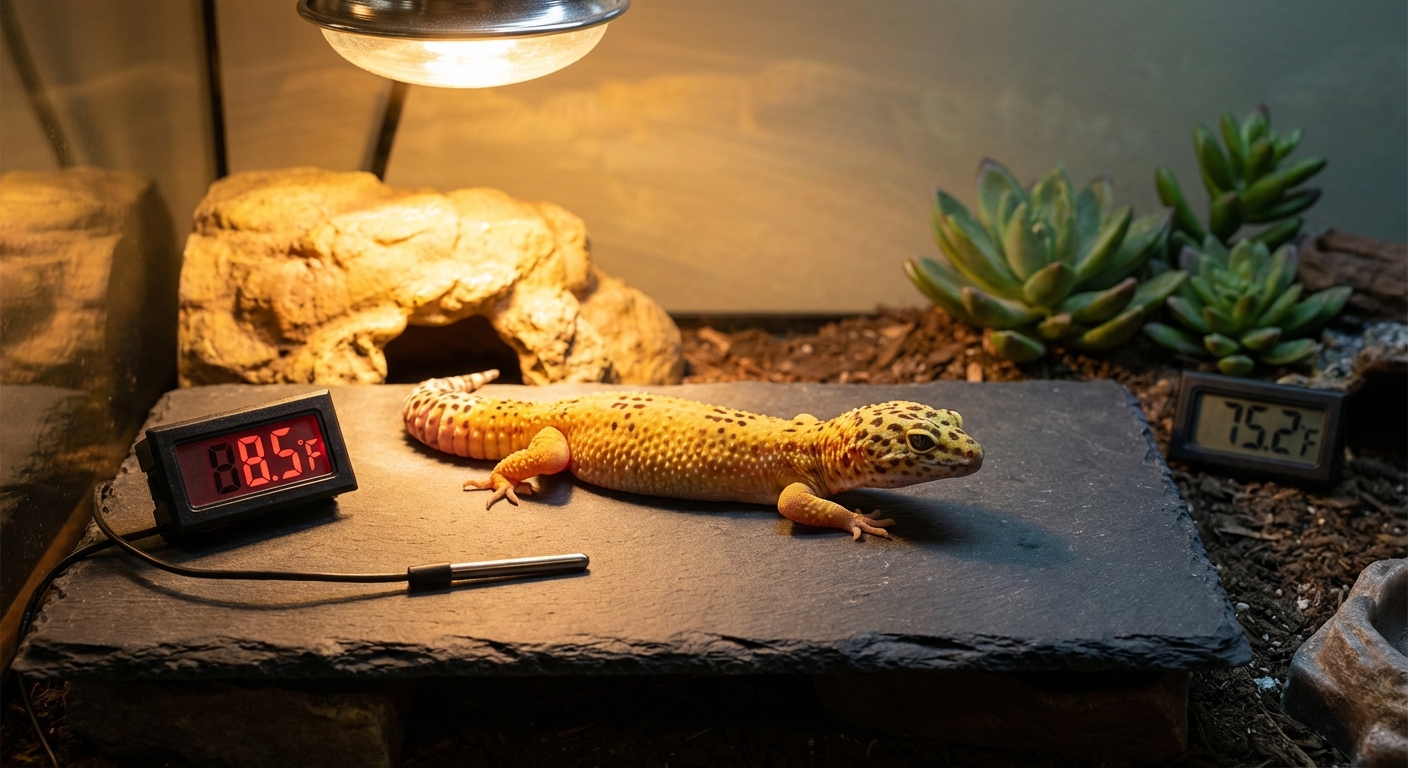
A leopard gecko tank needs a temperature gradient: a basking surface of 88-92°F (31-33°C) under the heat source, warm side air of 80-85°F (27-29°C), and a cool side of 70-77°F (21-25°C). At night the whole tank can drop to 65-75°F (18-24°C), but it should not fall below 65°F (18°C). Run every heat source on a thermostat and check the readings with a digital thermometer and an infrared temp gun.
infoQuick Answer: Ideal Temperatures
Basking surface 88-92°F (31-33°C). Warm side air 80-85°F (27-29°C). Cool side 70-77°F (21-25°C). Night 65-75°F (18-24°C), with 65°F (18°C) as the floor. Ambient humidity 30-40%, with a humid hide for shedding.
Leopard Gecko Temperature Chart
| Zone | Fahrenheit | Celsius | Where and how to measure |
|---|---|---|---|
| Basking surface | 88-92°F | 31-33°C | The floor or stone directly under the heat source, with an infrared temp gun |
| Warm side air | 80-85°F | 27-29°C | Digital thermometer probe a little above the floor at the warm end |
| Cool side | 70-77°F | 21-25°C | Digital thermometer probe at the far, unheated end |
| Night (whole tank) | 65-75°F | 18-24°C | Cool side reading at the coldest point of the night, usually just before dawn |
| Too hot | Above 95°F | Above 35°C | Any basking surface reading this high needs the thermostat turned down or the lamp raised |
| Too cold | Below 65°F | Below 18°C | Any night reading this low needs a light-free night heat source on a thermostat |
| Humidity | 30-40% ambient | 30-40% ambient | Digital hygrometer on the cool side; the humid hide runs higher, around 70-80% |
What Temperature Should a Leopard Gecko Tank Be?
A leopard gecko tank should not be one temperature. It needs a gradient that runs from one end to the other, with the heat source over or under one end only. Your gecko moves along that gradient as it needs to, basking after meals and retreating to the cool end to rest. A tank that is evenly warm everywhere, or evenly cool, takes that choice away.
Check the basking surface first, because it is where your gecko warms its belly to digest. Read it with an infrared temp gun, not with an air probe. Air probes placed above the floor read lower than the surface a gecko lies on, so a tank can look fine on the thermometer while the basking spot is too cool or too hot.
lightbulbMeasure at Surface Level
Point an infrared temp gun at the exact spot your gecko lies on under the heat source. That surface reading is your basking temperature. Use digital probe thermometers for the warm side air and the cool side.
Are Leopard Geckos Cold-Blooded?
Yes. Leopard geckos are ectotherms, the scientific term for cold-blooded animals, which means they do not produce their own body heat. Their body temperature follows their surroundings, and they control it by moving: into warmth to heat up, and into a cool hide to cool down. In the wild they do this between sun-warmed rocks and cooler burrows. In a tank, the gradient is what lets them do it.
That is why temperature affects so much of their health. A leopard gecko needs belly heat to digest a meal, and a gecko that cannot warm up enough may regurgitate food or stop eating. Its immune system also works best within its preferred temperature range, and a gecko kept too cool for long periods is more prone to illness, including respiratory infections.
warningSigns the Temperatures Are Wrong
Refusing food, regurgitating meals, lethargy, staying in one spot all the time, avoiding the warm side entirely, or resting with the mouth open can all point to temperatures that are off. Check the basking surface and cool side first. If the signs continue once temperatures are correct, see a reptile veterinarian.
Is 90°F Too Hot for a Leopard Gecko?
No, 90°F (32°C) is right in the middle of the basking surface range of 88-92°F (31-33°C). It is too hot as an air temperature across the whole tank, or on the cool side, because then your gecko has nowhere to cool down. Basking surfaces above about 95°F (35°C) are too hot, and contact surfaces over 100°F (38°C) can burn skin quickly. If your basking spot reads high, lower the thermostat set point or raise the heat lamp.
How Cold Is Too Cold for a Leopard Gecko?
Below 65°F (18°C) is too cold for a leopard gecko, day or night. During the day, a cool side under about 70°F (21°C) is cooler than it should be, and a basking surface that never reaches 88°F (31°C) is not warm enough for good digestion. A gecko kept cold for long stretches usually eats less, moves less, and digests slowly. If your room runs cold, raise the room temperature or add heat on a thermostat rather than letting the tank sit below these numbers.
Leopard Gecko Night Temperature
At night, the whole tank can drop to 65-75°F (18-24°C). A drop to 65-70°F (18-21°C) is natural and healthy, mirroring the cooler desert nights of the leopard gecko's native range. Below 65°F (18°C), digestion of the evening meal slows and the gecko is under strain.
If your room stays above 65°F year-round, you may not need any night heating. For colder rooms, use a heat source that gives off no light, such as a deep heat projector, a ceramic heat emitter, or a heat mat, on a thermostat. Never use colored night bulbs (red or blue), because they give off visible light that disrupts your gecko's day and night cycle.
Do Leopard Geckos Need Heat 24/7?
No. Leopard geckos need a warm basking spot during the day and a cooler night. Any heat lamp that gives off light, such as a halogen, should be on a 10-12 hour day schedule and off at night. Night heat is only needed when the room falls below 65°F (18°C), and then it should come from a light-free source on a thermostat. A deep heat projector is the one common heat lamp that can run around the clock, because it gives off almost no visible light.
Leopard Gecko Temperature and Humidity
Leopard geckos come from arid, rocky scrubland, and they do well at 30-40% ambient humidity, which matches the indoor humidity of most homes. The exception is the humid hide: a closed hide with damp moss or paper towel inside, kept at around 70-80% humidity, which helps your gecko shed cleanly. Place it on or near the warm side, since warmth drives the evaporation that keeps it humid. Measure ambient humidity with a digital hygrometer on the cool side.
Which Heat Source Should You Use?
The best choice depends on your room temperature and enclosure. Overhead heat warms both the air and the basking surface; a heat mat warms only the surface above it. Many keepers combine an overhead basking lamp for the day with a light-free source for cold nights. Our guide to the best heat lamp for leopard geckos compares bulb types and wattage in detail.
- check_circleDeep heat projector (DHP): infrared-A and infrared-B heat with almost no visible light, so it can run day and night. Use a dimming thermostat.
- check_circleHalogen flood bulb: bright light plus mostly infrared-A heat, the closest common match to sunlight. Daytime only, on a dimming thermostat.
- check_circleCeramic heat emitter (CHE): no light, longer-wave infrared that heats air more than the animal. Best as night backup, on a pulse proportional thermostat.
- check_circleUnder tank heater (heat mat): belly heat through a glass floor, covering about one third of the floor. Works in warmer rooms or as backup. On/off or pulse proportional thermostat.

Arcadia Deep Heat Projector (50W)
Emits infrared-A and infrared-B for deep tissue heating that mimics natural sunlight.
- check_circleProjects infrared-A and infrared-B heat
- check_circleVirtually no visible light, so it can run day and night
- check_circleStandard screw fitting, sold in 50W and 80W
Why You Must Use a Thermostat
warningNon-Negotiable Safety Equipment
Every heating device must be connected to a thermostat. Unregulated heat mats can climb past 110°F (43°C) and cause serious burns or crack glass tanks. This is not optional equipment.
A thermostat reads a probe and adjusts the heat source to hold your target temperature. There are three types. On/off thermostats switch power fully on and off; they are fine for heat mats. Pulse proportional thermostats send power in short pulses for steadier control, and suit ceramic heat emitters and mats. Dimming thermostats turn power up and down smoothly, and are the right match for halogens and deep heat projectors.
For an overhead lamp, place the probe just above the basking surface, out of the direct beam. For a heat mat, tape it to the inside of the glass directly above the mat. Check probe placement regularly, since it can shift over time, and confirm what the thermostat is doing with your own thermometer and temp gun.
How to Accurately Measure Temperatures
Analog dial thermometers sold in pet stores are often inaccurate by 5-10°F (3-6°C). Use digital equipment for readings you can trust.
- check_circleDigital probe thermometer: one probe on the warm side and one on the cool side to track air temperatures. Choose models with external probes.
- check_circleInfrared temperature gun: the only easy way to read the basking surface. Inexpensive models work well.
- check_circleDigital thermometer and hygrometer combo: tracks temperature and humidity together, useful on the cool side.
- check_circleAvoid: stick-on dial thermometers, LCD strip thermometers, and cheap all-in-one gauges.
Take readings at different times of day, since room temperature swings move the whole enclosure. A morning, afternoon, and pre-dawn reading in your first week shows how stable your setup really is. In winter, you may need extra night heat or a warmer room.
Common Temperature Mistakes to Avoid
- check_circleNo thermostat: the most dangerous mistake. Unregulated heat sources can burn your gecko or start fires.
- check_circleOnly measuring air temperature: the basking surface is what matters, and it reads higher than the air above it.
- check_circleUsing heat rocks: they develop hot spots and cause burns. Never use them.
- check_circleHeating both ends: this removes the gradient. Heat one end only.
- check_circleLeaving a light-emitting bulb on at night: it disrupts the day and night cycle. Use light-free night heat if you need any.
- check_circleTrusting pet store dial thermometers: they are often 5-10°F off. Use digital equipment.
- check_circleProbe in the wrong spot: it belongs at the basking surface, not floating in the air or buried under substrate.
Seasonal Temperature Adjustments
Room temperatures change with the seasons, and the enclosure follows. In summer, air conditioning can cool the tank more than you expect; in winter, nights can fall below 65°F (18°C) in rooms that were fine in autumn. Check your readings weekly when the weather turns and adjust thermostat settings or night heat as needed. Some experienced keepers let temperatures dip slightly in winter for breeding adults, but this is optional, and most pet leopard geckos do well on the same targets all year.
Frequently Asked Questions
What temperature should a leopard gecko tank be?expand_more
What temperature is too hot for a leopard gecko?expand_more
What temperature is too cold for a leopard gecko?expand_more
What temperature should a leopard gecko tank be at night?expand_more
Do leopard geckos need heat at night?expand_more
Can I use a heat rock for my leopard gecko?expand_more
How do I create a temperature gradient in a small tank?expand_more
Getting Leopard Gecko Temperatures Right
The right leopard gecko temperature is a range, not a single number: 88-92°F (31-33°C) at the basking surface, 70-77°F (21-25°C) on the cool side, and no lower than 65°F (18°C) at night. Heat one end only, run every heat source on a thermostat, and verify with a digital thermometer and an infrared temp gun. For hides, substrate, feeding and the rest of the setup, see our full leopard gecko care guide.