Leopard Gecko Care Guide for Beginners: Setup, Food and Heat
Everything a first-time owner needs: what to buy, how to set up the tank, the right temperatures, feeding and supplements, handling, and the mistakes to avoid.
Leopard Geckos Reptiles Team
Published · Last updated
infoDisclosure: This post contains affiliate links. As an Amazon Associate we earn from qualifying purchases, at no extra cost to you.
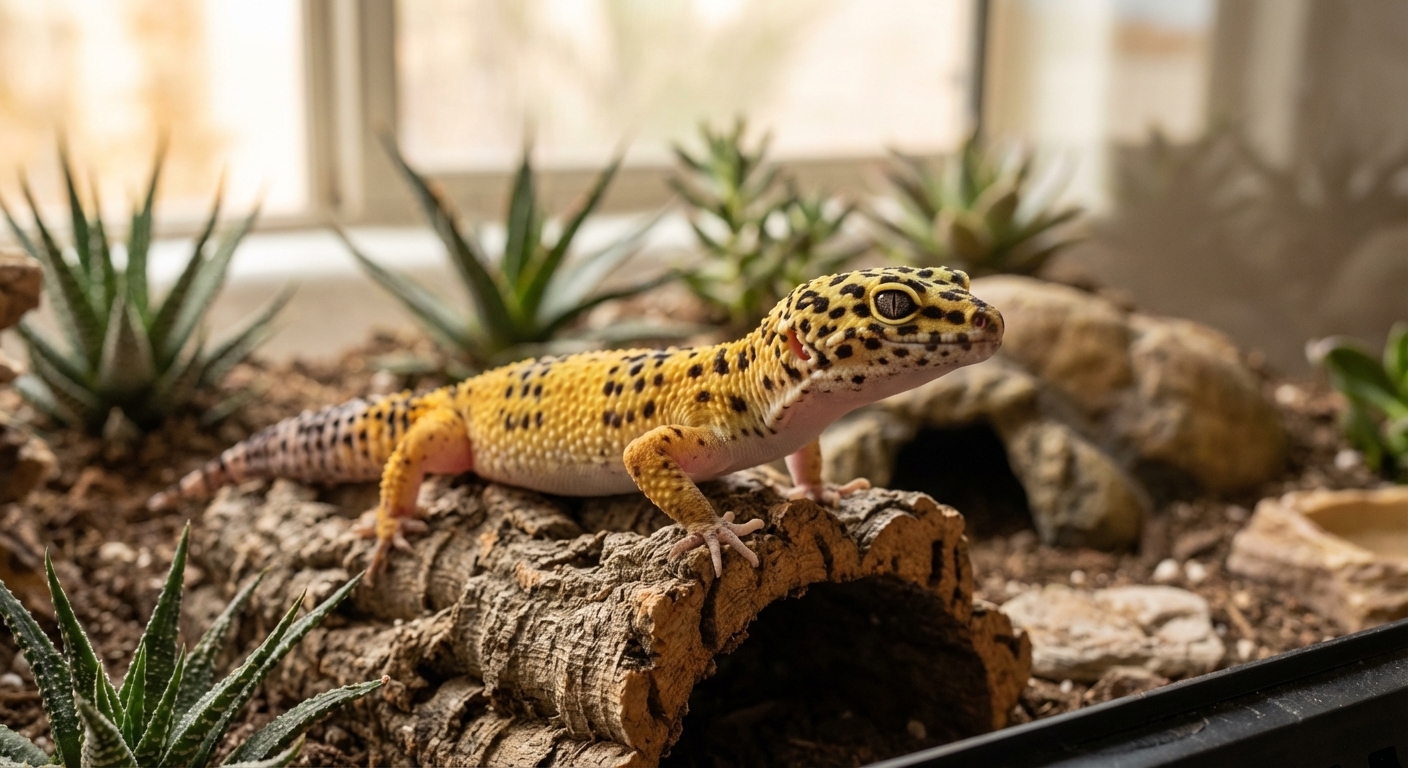
Leopard gecko care comes down to five things: a 20 gallon or larger enclosure (40 gallons is better for an adult), a warm-to-cool temperature gradient with a basking surface of 88-92°F (31-33°C), three hides including a humid hide, a solid substrate, and live insects dusted with calcium. Leopard geckos are calm, ground-dwelling lizards that live 15 to 20 years with good care, which makes them one of the easiest reptiles to start with.
infoQuick Care Summary
Enclosure: 20 gallon minimum, 40 gallon recommended. Temperatures: 88-92°F (31-33°C) basking surface, 70-77°F (21-25°C) cool side, not below 65°F (18°C) at night. Hides: warm, cool and humid. Food: gut-loaded live insects dusted with calcium, daily for juveniles and every 2-3 days for adults. Lifespan: 15-20 years.
Leopard Gecko Care Sheet at a Glance
| Need | What a leopard gecko needs |
|---|---|
| Enclosure | 20 gallon minimum for one adult, 40 gallon breeder or larger recommended; floor space matters more than height |
| Basking surface | 88-92°F (31-33°C), measured with an infrared temp gun |
| Warm side air | 80-85°F (27-29°C) |
| Cool side | 70-77°F (21-25°C) |
| Night | 65-75°F (18-24°C); no lower than 65°F (18°C) |
| Heat source | Overhead heat lamp or heat mat on one end, always on a thermostat |
| Humidity | 30-40% ambient, with a humid hide at around 70-80% |
| Hides | Three: warm side, cool side, and a humid hide |
| Substrate | Solid options such as paper towel or slate tile, especially for juveniles |
| Diet | Live, gut-loaded insects: dubia roaches, crickets, black soldier fly larvae, with mealworms and hornworms as extras |
| Feeding | Juveniles daily; adults every 2-3 days |
| Supplements | Calcium on every feeding (with D3 if you do not use UVB), multivitamin once or twice a week |
| Lighting | A 10-12 hour day and night cycle; low-level UVB is beneficial but optional with proper supplements |
| Housing | One gecko per enclosure |
| Lifespan | 15-20 years |
Are Leopard Geckos Good for Beginners?
Yes. Leopard geckos are one of the easiest reptiles to start with. They stay small, at 8-10 inches as adults, are calm and slow-moving, rarely bite, and usually tolerate handling once settled. They live on the ground and lack the sticky toe pads of climbing geckos, so they are easier to house and handle than arboreal species. Daily care takes about 5-10 minutes.
Leopard geckos (Eublepharis macularius) come from the rocky, dry grasslands of Afghanistan, Pakistan, and northwest India. Unlike most geckos they have moveable eyelids, and they come in dozens of color morphs, from the classic yellow and black spotted pattern to albinos, blizzards, and designer morphs.
What Are the Downsides of Owning a Leopard Gecko?
Leopard geckos still have drawbacks. Before you buy, make sure you are comfortable with these:
- check_circleLive insects: leopard geckos eat live insects only, so you will keep and feed crickets, dubia roaches, or worms at home.
- check_circleA long commitment: 15-20 years is longer than many dogs live.
- check_circleMost active at dawn and dusk: they are crepuscular, so you will see the most activity in the early morning and evening.
- check_circleSpecialist vet care: an ill gecko needs a reptile veterinarian, and not every area has one nearby.
- check_circleHeating equipment: the enclosure needs a heat source and thermostat running every day.
What Do I Need for My First Leopard Gecko?
Set the enclosure up and run it for a few days before your gecko arrives, so you can confirm the temperatures are stable. This is the full shopping list:
- check_circleEnclosure: a 20 gallon long tank at minimum, or a 40 gallon breeder or similar for an adult. Front-opening enclosures make access less stressful.
- check_circleHeat source: an overhead heat lamp such as a deep heat projector or halogen bulb, or a heat mat in a warm room.
- check_circleThermostat: matched to the heat source, a dimming thermostat for heat lamps and an on/off or pulse proportional model for a heat mat.
- check_circleDigital thermometer with probes, plus an infrared temp gun for the basking surface.
- check_circleThree hides: one warm, one cool, and one humid hide with damp sphagnum moss or paper towel.
- check_circleSubstrate: paper towel or slate tile to start.
- check_circleA shallow water dish and a small feeding dish.
- check_circleCalcium powder (with and without D3) and a reptile multivitamin.
- check_circleLive feeder insects, plus a container and food to gut-load them.
- check_circleOptional: a low-level UVB light on a timer.
How Do I Choose a Healthy Leopard Gecko?
Look the gecko over in person, or ask the breeder for recent photos, before you pay. A healthy leopard gecko shows these signs:
- check_circleClear, bright eyes with no discharge or cloudiness
- check_circleA plump, rounded tail, since the tail is where it stores fat
- check_circleNo visible ribs or hip bones
- check_circleA clean vent with no stuck feces or discharge
- check_circleSmooth skin with no stuck shed, wounds or lumps, especially on the toes and tail tip
- check_circleAlert and responsive when awake
For a first gecko, a sub-adult or adult is the easier start. Hatchlings and young juveniles need daily feeding and are more fragile, while an older gecko eats every 2-3 days and is more forgiving while you learn.
Setting Up the Enclosure
Your leopard gecko's enclosure is the foundation of good care. A 20 gallon tank is the minimum for one adult, but a 40 gallon breeder tank or equivalent gives more room and makes a temperature gradient easier to hold. Floor space matters more than height for this ground-dwelling species.
- check_circleJuveniles (under 6 months): 10-20 gallon minimum
- check_circleAdults: 20 gallon minimum, 40 gallon recommended
- check_circleHeat one end only, so the far end stays cool
- check_circlePlace hides at both ends, plus the humid hide on or near the warm side
Leopard geckos need three hides to feel secure: a warm hide on the heated side, a cool hide on the unheated side, and a humid hide for shedding. The humid hide holds damp sphagnum moss or coconut fiber; check it daily so it stays moist. For the substrate, solid options such as paper towel or slate tile carry no impaction risk and are the safest choice for juveniles.
Temperature and Heating
Leopard geckos are cold-blooded, so they warm up from their surroundings and need a gradient to move along: a warm basking spot at one end and a cool retreat at the other. Proper temperatures drive digestion, immune function, and activity. The full chart, with Fahrenheit and Celsius and how to measure each zone, is in our leopard gecko temperature guide.
Basking Surface
88-92°F (31-33°C)
Warm Side Air
80-85°F (27-29°C)
Cool Side
70-77°F (21-25°C)
Night (all areas)
65-75°F (18-24°C)
An overhead heat lamp is the best single heat source because it warms both the air and the basking surface. A deep heat projector or a halogen flood bulb on a dimming thermostat is the usual choice; see our guide to the best heat lamp for leopard geckos for bulb types and wattage. A heat mat works in rooms that stay above about 68°F (20°C). Every heat source runs on a thermostat.
warningAvoid Heat Rocks
Never use heat rocks with leopard geckos. They develop hot spots and can cause severe belly burns. Use an overhead heat lamp or an under tank heater on a thermostat instead.
Do I Turn Off the Heat Lamp at Night?
Yes, turn off any heat lamp that gives off light, such as a halogen, at night. Leopard geckos need a dark night and a natural temperature drop. If your room stays above 65°F (18°C), you need no night heat at all. If it gets colder, use a heat source that gives off no light, such as a deep heat projector, ceramic heat emitter, or heat mat on a thermostat. Avoid red or blue night bulbs, which disturb the day and night cycle.
How Cold Is Too Cold for a Leopard Gecko at Night?
Below 65°F (18°C) is too cold. A night drop to 65-70°F (18-21°C) is healthy, but colder than that slows digestion of the evening meal. Check the cool side at the coldest point of the night, usually just before dawn, when the weather turns cold.
What Do Leopard Geckos Eat?
Leopard geckos are insectivores and eat only live insects. The keys to a healthy diet are variety, gut-loading (feeding the insects nutritious food before you offer them), and calcium supplementation, which together prevent metabolic bone disease and other deficiencies.
- check_circleDubia roaches: good nutrition, easy to digest, little smell
- check_circleCrickets: widely available, good protein source
- check_circleBlack soldier fly larvae: high in calcium, good for variety
- check_circleMealworms: fine as part of the rotation, higher in fat
- check_circleHornworms: a hydrating treat, offer sparingly
Feed juveniles (under 12 months) daily, offering as many appropriately sized insects as they will eat in about 15 minutes. Adults eat every 2-3 days. Dust insects with calcium at every feeding (with D3 if you do not use UVB lighting), and use a multivitamin once or twice a week. Keep a shallow dish of fresh water in the enclosure at all times.
What Should I Do in the First Week?
Leave your gecko alone. The move is stressful, and for the first few days it only needs correct temperatures, fresh water and privacy. Offer a few small insects from about day three, and do not worry if it refuses them. It is normal for a new leopard gecko to hide most of the time and skip food for up to a week. Most settle in within one to two weeks. Hold off on handling until it is eating regularly.
Daily, Weekly and Monthly Care
| How often | What to do |
|---|---|
| Daily | Check the thermometers, spot clean waste (most geckos pick one corner), refresh the water, feed on schedule |
| Weekly | Re-dampen the humid hide, scrub the water dish, top up the calcium dish |
| Monthly | Deep clean the enclosure, replace the humid hide moss, check the heat source and thermostat against a thermometer, weigh your gecko |
Handling and Taming
Give a new leopard gecko time to settle before handling. Wait at least two weeks after bringing it home, then start with short sessions of 5-10 minutes and build up as your gecko becomes comfortable. Scoop it up from below rather than grabbing from above, and never hold or pull it by the tail, which it can drop when stressed.
lightbulbBuilding Trust
Rest your hand in the enclosure without grabbing for several days. Let your gecko approach and investigate. This builds trust and makes future handling less stressful for both of you.
Is It Better to Have 1 or 2 Leopard Geckos?
One. Leopard geckos are solitary and do not need a companion. Housing two together causes stress and can lead to fighting, injuries, and one gecko out-competing the other for food and the best warm spot. Even females housed together may fight, and a male and female together will breed. If you want two leopard geckos, give each its own enclosure.
What Stresses Leopard Geckos Out?
- check_circleWrong temperatures, especially no warm basking spot or no cool retreat
- check_circleToo few hides, or hides only on one side of the enclosure
- check_circleSharing an enclosure with another gecko
- check_circleHandling too soon after arrival, or grabbing from above
- check_circleBright or colored lights at night
- check_circleFrequent rearranging of the enclosure, loud rooms, or other pets pressing against the glass
A stressed gecko often hides constantly, refuses food, or paces and climbs at the glass. Fix the setup first. If the behavior continues once the husbandry is right, see a reptile veterinarian.
What Not to Do With a Leopard Gecko
- check_circleDo not run any heat source without a thermostat.
- check_circleDo not use heat rocks.
- check_circleDo not house leopard geckos together.
- check_circleDo not use loose sand or other loose substrate for juveniles.
- check_circleDo not grab or hold your gecko by the tail.
- check_circleDo not leave a light-emitting bulb on at night.
- check_circleDo not skip calcium dusting.
- check_circleDo not trust pet store dial thermometers; use digital ones and a temp gun.
Health and Common Issues
A healthy leopard gecko is alert, has bright eyes and a plump tail, and eats regularly. Watch for lethargy, weight loss, stuck shed, runny stool, or loss of appetite. Many health issues trace back to husbandry, particularly incorrect temperatures or missing calcium.
- check_circleMetabolic bone disease (MBD): caused by calcium or vitamin D3 deficiency
- check_circleStuck shed: usually from low humidity, especially on the toes and tail tip
- check_circleImpaction: can occur from swallowing loose substrate
- check_circleParasites: more common in poorly sourced geckos
- check_circleRespiratory infections: often linked to temperatures that are too low
warningWhen to See a Vet
If your leopard gecko shows signs of illness, stops eating for more than two weeks, has visible injuries, or shows a dramatic change in behavior, consult a reptile veterinarian promptly. Early care often means better outcomes.
Frequently Asked Questions
Are leopard geckos easy to take care of?expand_more
How long do leopard geckos live?expand_more
Can leopard geckos live together?expand_more
Do leopard geckos need UVB lighting?expand_more
Why is my leopard gecko not eating?expand_more
How often do leopard geckos shed?expand_more
Are leopard geckos good pets for kids?expand_more
Final Thoughts
Good leopard gecko care is mostly about getting the setup right once: a large enough enclosure, a stable warm-to-cool gradient on a thermostat, three hides, a safe substrate, and a calcium-dusted insect diet. After that, care is a few minutes a day. Watch how your gecko behaves, adjust as needed, and it can be a companion for 15 to 20 years. If you have questions about your specific setup, get in touch and we will help you work through it.