Leopard Gecko Heating: Best Heat Sources & Setup Guide (2026)
Find the best heating solution for your leopard gecko with our comprehensive comparison of heat mats, DHPs, CHEs, and halogen bulbs.
Leopard Geckos Reptiles Team
Published
infoDisclosure: This post contains affiliate links. As an Amazon Associate we earn from qualifying purchases, at no extra cost to you.
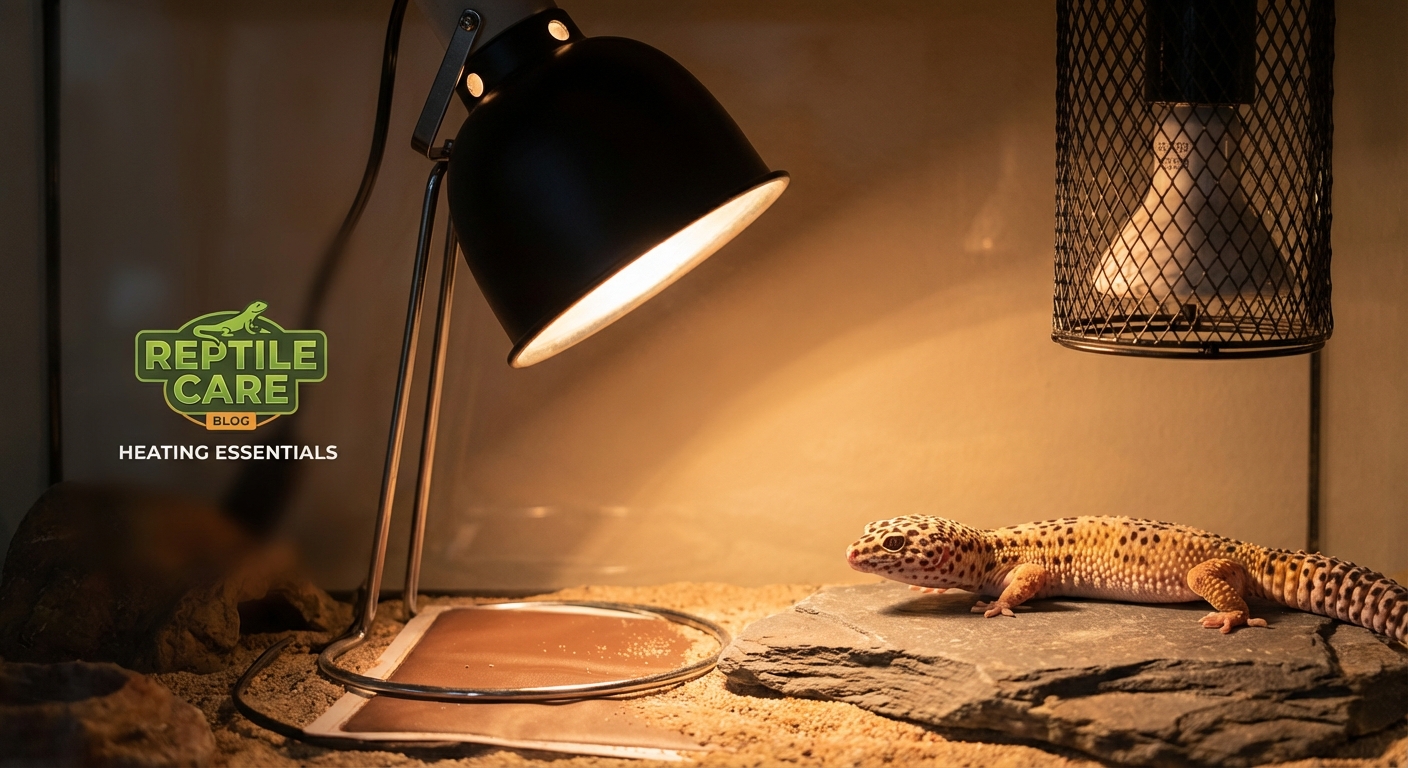
Choosing the right heating equipment is one of the most important decisions in leopard gecko husbandry. The heat source you select affects temperature control, energy efficiency, enclosure type compatibility, and your gecko overall health. This guide compares all major heating options, explains the science behind each, and helps you choose the best setup for your specific situation.
infoQuick Heating Recommendations
For glass tanks: Under tank heater (heat mat) with thermostat works well. For PVC enclosures: Deep heat projector or halogen bulb is ideal. For cold rooms: Ceramic heat emitter for nighttime supplemental heat. Always use a thermostat with any heating device. Target 88-92°F (31-33°C) basking surface temperature.
Leopard Gecko Heating Basics
Leopard geckos are ectothermic reptiles that require external heat sources to regulate their body temperature. In their natural habitat, they absorb heat from sun-warmed rocks and sand. In captivity, we must provide heat that allows them to thermoregulate by moving between warm and cool zones.
The goal is not just warm air, but appropriate surface temperatures. Belly heat is particularly important for digestion. When a leopard gecko eats, it moves to a warm surface to facilitate the digestive process. Without adequate belly heat, food can stagnate and cause serious health problems.
Types of Heat Transfer
- check_circleConduction: Heat transferred by direct contact (sitting on warm surfaces). Heat mats provide primarily conductive heat.
- check_circleConvection: Heat transferred through moving air. Ceramic heat emitters primarily heat the air.
- check_circleRadiation: Heat transferred through infrared waves. Deep heat projectors and halogen bulbs provide radiant heat.
- check_circleOptimal setup: Radiant heat that warms surfaces (mimicking natural sun-warmed rocks) is considered most natural and beneficial.
Under Tank Heaters (Heat Mats)
Under tank heaters (UTH) are adhesive heating pads that attach to the bottom outside of glass enclosures. They have been the standard heating method for leopard geckos for decades and remain popular due to their low cost and simplicity.
How Heat Mats Work
Heat mats generate warmth through electrical resistance and transfer it through the glass bottom into the substrate and enclosure floor. The gecko receives heat by lying on the warmed surface. This provides excellent belly heat for digestion when properly set up.
Heat Mat Advantages
- check_circleAffordable: $15-30 for most sizes, lowest entry cost
- check_circleSimple installation: Peel and stick application
- check_circleGood belly heat: Direct contact warming aids digestion
- check_circleNo light emission: Works 24/7 without disrupting light cycles
- check_circleLow energy consumption: Typically 8-16 watts
Heat Mat Disadvantages
- check_circleOnly works with glass-bottom enclosures placed directly on the mat
- check_circleDoes not heat air or ambient temperatures effectively
- check_circleCannot be used with PVC, wood, or plastic enclosures
- check_circleCan overheat and cause burns or crack glass without thermostat
- check_circleSubstrate depth affects heat transfer efficiency
warningThermostat Required
Heat mats can reach 120°F+ without regulation, causing severe burns or glass cracking. Never operate a heat mat without a thermostat. This is a non-negotiable safety requirement.
Deep Heat Projectors (DHP)
Deep heat projectors are a newer technology that has rapidly become the preferred heating method among experienced keepers. They emit infrared-A and infrared-B radiation, which closely mimics natural sunlight in terms of heat quality.

Arcadia Deep Heat Projector (50W)
Emits infrared-A and infrared-B for deep tissue heating that mimics natural sunlight.
- check_circleProjects infrared-A and infrared-B heat
- check_circleVirtually no visible light, so it can run day and night
- check_circleStandard screw fitting, sold in 50W and 80W
How DHPs Work
Unlike heat mats that work through conduction, DHPs emit radiant infrared energy that penetrates deeply and warms surfaces from above. This creates a basking zone similar to natural sun exposure. The infrared-A and B wavelengths penetrate the gecko skin and provide deep tissue warmth, supporting metabolism and overall health.
DHP Advantages
- check_circleMost natural heat type: Mimics sun-warmed surfaces
- check_circleDeep tissue warming: Infrared-A/B penetrates for metabolic benefits
- check_circleWorks with any enclosure: PVC, glass, wood, all compatible
- check_circleNo light emission: Safe for 24-hour use
- check_circleLong lifespan: 25,000+ hours typical
- check_circleCreates natural basking gradient
DHP Disadvantages
- check_circleHigher initial cost: $40-70 for quality units
- check_circleRequires ceramic socket and dome fixture
- check_circleMust use with thermostat (dimming or on/off)
- check_circleTakes up fixture space above enclosure
- check_circleMay need larger wattage in cold rooms
Ceramic Heat Emitters (CHE)
Ceramic heat emitters are screw-in heating elements that emit infrared-C radiation. They have been used in reptile keeping for years and remain useful for specific applications, though DHPs have largely surpassed them for primary heating.
How CHEs Work
CHEs produce long-wave infrared (IR-C) that primarily heats the air rather than surfaces. The heated air then warms objects through convection. This makes them effective for raising ambient temperatures but less efficient at creating focused basking spots.
CHE Advantages
- check_circleNo light output: Safe for nighttime use
- check_circleWidely available: Found in most pet stores
- check_circleGood for ambient heating: Raises overall enclosure temperature
- check_circleModerate cost: $15-35 typically
- check_circleDurable: Long lifespan with no fragile components
CHE Disadvantages
- check_circleLess natural heat type: IR-C does not mimic sunlight
- check_circleHeats air more than surfaces: Less effective for basking
- check_circleCan significantly dry out enclosures
- check_circleLess efficient than DHPs for reptile metabolism
- check_circleBetter suited as supplemental heating than primary source
CHEs work well as secondary heating in cold rooms or for maintaining nighttime minimum temperatures. They are less ideal as the sole heat source compared to DHPs or properly set up heat mats.
Halogen Flood Bulbs
Halogen flood bulbs produce the most natural heat spectrum available, combining visible light with infrared-A and infrared-B radiation. They most closely replicate natural sunlight heating and are increasingly popular among keepers who want the most naturalistic setup.
Halogen Advantages
- check_circleMost natural spectrum: Closest to real sunlight
- check_circleExcellent surface heating: Creates defined basking spots
- check_circleAffordable: Standard halogen floods cost $3-10
- check_circleWidely available: Hardware stores stock them
- check_circleVisible light provides day cycle
Halogen Disadvantages
- check_circleProduces light: Must be turned off at night
- check_circleRequires secondary heat source if night temps drop
- check_circleShorter lifespan than DHPs: 2,000-5,000 hours
- check_circleMust use with dimming thermostat to prevent flickering
Many experienced keepers use a halogen bulb during the day combined with a DHP or CHE for nighttime heating. This provides the most natural heat experience while maintaining appropriate temperatures around the clock.
Heating Method Comparison
Each heating method has its place depending on your enclosure type, budget, and goals. Here is how they compare for key factors important to leopard gecko husbandry.
- check_circleBest for glass tanks: Heat mat (affordable, effective belly heat) OR DHP/halogen mounted overhead
- check_circleBest for PVC enclosures: Deep heat projector (heat mats ineffective through PVC)
- check_circleBest budget option: Heat mat with thermostat (under $50 total setup)
- check_circleBest naturalistic heat: Halogen daytime + DHP nighttime
- check_circleBest for cold rooms: DHP or CHE with higher wattage
- check_circleBest 24/7 solution: DHP (no light, natural IR spectrum)
Essential: Thermostats for Safety
Every heating device requires a thermostat. This is not optional. Thermostats prevent overheating that can burn your gecko, start fires, or crack glass enclosures. They also help maintain stable temperatures for optimal health.
Thermostat Types
- check_circleOn/off (pulse) thermostats: Budget option, turns power completely on or off. Works well for heat mats, CHEs, and DHPs.
- check_circleProportional thermostats: Better temperature stability, gradually adjusts power. Good for all non-light-emitting sources.
- check_circleDimming thermostats: Required for halogen bulbs to prevent flickering. Also works with DHPs and CHEs.
- check_circleRecommendation: Invest in a quality dimming thermostat for versatility across all heat sources.
Frequently Asked Questions
What wattage heat mat do I need?expand_more
Can I use a heat rock for my leopard gecko?expand_more
Do I need multiple heat sources?expand_more
How do I heat a PVC enclosure?expand_more
My heat mat does not reach the right temperature. What should I do?expand_more
Choosing Your Heating Setup
The best heating method depends on your specific situation. For budget glass tank setups, a quality heat mat with thermostat remains effective and affordable. For PVC enclosures or those wanting the most naturalistic heating, deep heat projectors offer the best combination of quality and versatility. Whatever you choose, always use a thermostat, verify temperatures with digital thermometers and a temp gun, and ensure your gecko has access to a proper temperature gradient.