Best UVB Light for Leopard Geckos (2026 Reviews)
Modern husbandry standards now recommend low-level UVB for leopard geckos. We review the top purpose-built option and explain exactly how to set it up.
Leopard Geckos Reptiles Team
Published
infoDisclosure: This post contains affiliate links. As an Amazon Associate we earn from qualifying purchases, at no extra cost to you.
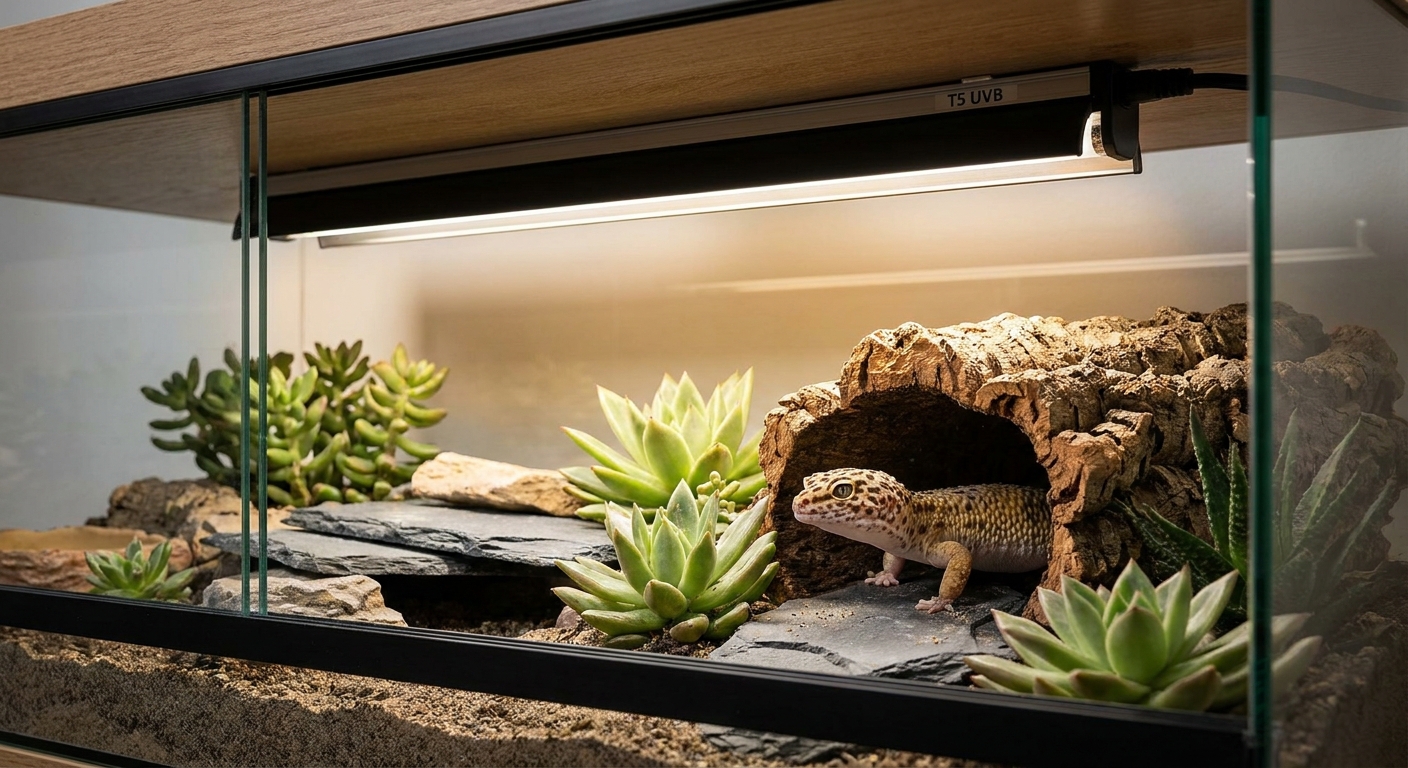
The best UVB light for a leopard gecko is a low-output lamp designed for Ferguson Zone 1 species, delivering a UV Index (UVI) of 0.3-1.0 at the basking spot. Leopard geckos can survive without UVB when they receive dietary vitamin D3, but modern husbandry standards now recommend low-level UVB because it lets your gecko produce its own vitamin D3 naturally. The Arcadia ShadeDweller ProT5 7% is the standout purpose-built option, and it is the lamp this guide focuses on.
infoQuick Answer
The Arcadia ShadeDweller ProT5 7% is the best UVB light for leopard geckos. It is purpose-built for crepuscular, low-light species (Ferguson Zone 1), producing a gentle UVI of 0.3-1.0 when mounted roughly 10-15 inches (25-38 cm) above the basking area. Run it 10-12 hours per day on a timer and replace the bulb every 12 months.
This article contains affiliate links. We may earn a commission if you purchase through our links, at no extra cost to you. This helps support our content.
Do Leopard Geckos Need UVB Lighting?
The honest answer is nuanced. Leopard geckos are crepuscular, meaning they are most active at dawn and dusk, and for decades keepers raised healthy geckos without any UVB by dusting feeder insects with a supplement containing vitamin D3. Dietary D3 works, and plenty of long-lived geckos prove it. So UVB is not required for survival in the way heat is.
That said, the evidence has shifted. Peer-reviewed research on leopard geckos has shown that even short daily exposure to low-level UVB significantly raises blood levels of vitamin D3 compared to unexposed animals. Self-regulated D3 synthesis is difficult to overdose, unlike dietary supplementation, and wild leopard geckos do encounter filtered sunlight at dawn and dusk and while resting near burrow entrances.
For these reasons, modern husbandry guidelines classify the leopard gecko as a Ferguson Zone 1 species. Zone 1 covers crepuscular and shade-dwelling reptiles that benefit from a low UV Index of 0.3-1.0 at the highest point they can bask. That is a fraction of what a bearded dragon or uromastyx needs, which is why lamp choice matters so much here.
- check_circleFerguson Zone: 1 (crepuscular, shade dweller)
- check_circleTarget UV Index at basking point: 0.3-1.0
- check_circlePhotoperiod: 10-12 hours of light per day, matched to your heat cycle
- check_circleAlternative: dietary vitamin D3 via supplement dusting, which remains a valid approach
The practical takeaway: your leopard gecko will not fail without UVB if your supplementation routine is solid. But a correctly installed low-level UVB lamp supports natural D3 production, encourages natural cryptic basking behavior, and adds a margin of safety against metabolic bone disease. Most keepers who add it consider it a worthwhile upgrade.
Best Overall: Arcadia ShadeDweller ProT5 7%

Arcadia ShadeDweller ProT5 UVB Kit (7%)
Low-output T5 UVB kit designed specifically for crepuscular, shade-dwelling species like leopard geckos. Provides Ferguson Zone 1 UVB for natural vitamin D3 synthesis.
- check_circleDesigned for shade-dwelling species
- check_circle7% UVB T5 lamp with reflector included
- check_circleCompact 8W fixture with mounting hardware
The Arcadia ShadeDweller ProT5 7% is the only widely available UVB kit designed specifically for crepuscular species like leopard geckos, and that focus shows. The complete unit combines a slim T5 fixture with a built-in reflector and a low-output 7% UVB tube. The reflector matters: it directs the modest UV output downward efficiently, so the lamp achieves the target UVI of 0.3-1.0 at realistic mounting distances instead of requiring the tube to sit uncomfortably close to your gecko.
Mounting height is the key setup decision. Position the fixture roughly 10-15 inches (25-38 cm) above the basking surface. Use the closer end of that range when mounting above a mesh screen top, because standard mesh blocks a meaningful share of UVB output, and the farther end when mounting inside the enclosure with no mesh in the path. If you can borrow or buy a Solarmeter 6.5 UV Index meter, verify the reading at the basking spot and adjust height until it falls between 0.3 and 1.0.
Two placement rules complete the picture. First, mount the ShadeDweller over the warm side of the enclosure, directly alongside your heat lamp, so heat and UVB overlap in a single sun zone. In nature, warmth and sunlight arrive together, and reptiles seek UV where they seek heat. Second, plan on replacing the tube every 12 months. UVB output decays long before visible light does, so a tube that still looks bright can be producing little usable UVB by month 14 or 15. The kit typically runs around $40-60, with replacement tubes costing less.
How Do You Set Up UVB Correctly?
A UVB lamp only helps if the ultraviolet light actually reaches your gecko at the right intensity. Follow these steps to get the installation right the first time.
- check_circle1. Choose the mounting position: place the fixture over the warm side of the enclosure, next to the heat source, covering roughly one third to one half of the enclosure length so a UV gradient forms.
- check_circle2. Set the distance: start at about 10-15 inches (25-38 cm) between the lamp and the highest basking surface, then verify with a UV Index meter if possible.
- check_circle3. Account for mesh: a standard screen top blocks roughly 30-40% of UVB output, so mount closer (or use a lamp designed for over-mesh use) when the light shines through a screen.
- check_circle4. Remove glass and plastic from the light path: ordinary glass and acrylic block nearly all UVB, so never position the lamp behind a glass lid, plastic cover, or terrarium wall.
- check_circle5. Put the lamp on a timer: run it 10-12 hours on and 12-14 hours off, synced with your daytime heat, so your gecko gets a consistent day-night cycle with complete darkness at night.
- check_circle6. Provide shade: keep at least two hides and some cover within the UV zone and a fully shaded cool side, so your gecko can regulate its own exposure.
Check the basking distance again after any layout change. Adding a taller hide or a stacked slate basking platform under the lamp can cut the distance by several inches and push the UVI above the Zone 1 target without you noticing.
One more note on fixtures. Compact coil UVB bulbs and bare tubes without reflectors are widely sold, but they are a poor fit here. Coil bulbs concentrate output in a small, patchy footprint, and an unreflected tube loses much of its UVB upward into the hood. A linear T5 fixture with a reflector, sized to cover about one third to one half of the enclosure, gives the even, predictable gradient that a Ferguson Zone 1 setup depends on.
What About Albino and Sensitive Morphs?
Albino leopard geckos, and light-sensitive morphs in general, need extra care with UVB. Albino animals have reduced pigment, which means less natural protection in both the skin and the eyes. Many albino geckos squint or hide more under bright lighting, and prolonged exposure at normal intensities may be uncomfortable for them.
You do not necessarily have to skip UVB for these animals, but you should lower the dose. Aim for the bottom of the Zone 1 range, a UVI of around 0.3-0.5 rather than 1.0, by increasing the mounting distance or letting mesh attenuate the output. Watch behavior closely for the first few weeks. A gecko that basks briefly and retreats is self-regulating normally; a gecko that never leaves its hides during the day may be telling you the light is too intense.
Shade is the real safety mechanism. Provide multiple hides, cork bark, and plant cover throughout the enclosure, including within the UV zone itself, so the gecko can choose partial exposure. If an albino gecko consistently avoids the lit area, it is reasonable to rely on dietary D3 supplementation instead. Both paths can produce a healthy animal.
Pairing UVB With a Heat Source

Arcadia Deep Heat Projector (50W)
Emits infrared-A and infrared-B for deep tissue heating that mimics natural sunlight.
- check_circleProjects infrared-A and infrared-B heat
- check_circleVirtually no visible light, so it can run day and night
- check_circleStandard screw fitting, sold in 50W and 80W
A common misconception is that a UVB lamp handles heating too. It does not. The ShadeDweller and similar T5 fixtures produce almost no usable warmth, so your leopard gecko still needs a dedicated heat source to reach a basking surface temperature of 90-94°F (32-34°C). A deep heat projector or halogen basking lamp on a thermostat fills that role well.
Mount the heat source and the UVB fixture side by side over the warm end. This pairing recreates a single sun zone where your gecko warms up and absorbs UVB at the same time, which is exactly how basking works in the wild. Keep both on the same daytime schedule if your home stays warm at night, or let a non-light-emitting heater run around the clock on a thermostat while the UVB follows the 10-12 hour photoperiod.
warningDo Not Use Desert-Strength UVB
Never use a high-output UVB lamp intended for desert basking species, such as a 10% or 12% tube or a powerful mercury vapor bulb, at close range over a leopard gecko. These lamps target Ferguson Zones 3-4 and can push the UV Index far beyond the 0.3-1.0 a leopard gecko should receive, risking eye irritation and skin damage. Whatever lamp you choose, always provide shaded hides so your gecko can escape the light completely.
If you use an under-tank heat mat instead of an overhead heat source, the same principle applies: place the UVB fixture above the warm end where the mat sits. Skip heat rocks entirely, as they heat unevenly and can burn reptiles, and avoid red night lights, which disturb the day-night cycle. A thermostat-controlled heater plus a timed ShadeDweller covers everything a leopard gecko needs from its lighting and heating.
Frequently Asked Questions
Can leopard geckos live without UVB?expand_more
What UVB percentage is right for a leopard gecko?expand_more
How far should the UVB light be from my leopard gecko?expand_more
How long should the UVB light stay on each day?expand_more
How often should I replace a UVB bulb?expand_more
Should I still dust insects with D3 if I use UVB?expand_more
Final Verdict: Which UVB Light Should You Buy?
For nearly every leopard gecko keeper, the best UVB light for a leopard gecko is the Arcadia ShadeDweller ProT5 7%. It is the one mainstream kit engineered around the Ferguson Zone 1 target of UVI 0.3-1.0, it includes the fixture and reflector in one package, and setup is straightforward: mount it 10-15 inches (25-38 cm) above the warm-side basking area, run it 10-12 hours daily on a timer, and replace the tube every 12 months.
Pair it with a proper heat source to build one combined sun zone, keep plenty of shaded hides available, and back it up with a sensible supplement routine. Your gecko does not need intense lighting to thrive; it needs the right low dose delivered consistently. If UVB is not practical for your setup, careful dietary D3 supplementation remains a legitimate path, and either way your leopard gecko can live a long, healthy life.