Do Leopard Geckos Like to Be Held? (Honest Answer)
Leopard geckos tolerate handling rather than enjoy it, but they can learn to associate you with safety. Here is the honest answer and how to handle them well.
Leopard Geckos Reptiles Team
Published
infoDisclosure: This post contains affiliate links. As an Amazon Associate we earn from qualifying purchases, at no extra cost to you.
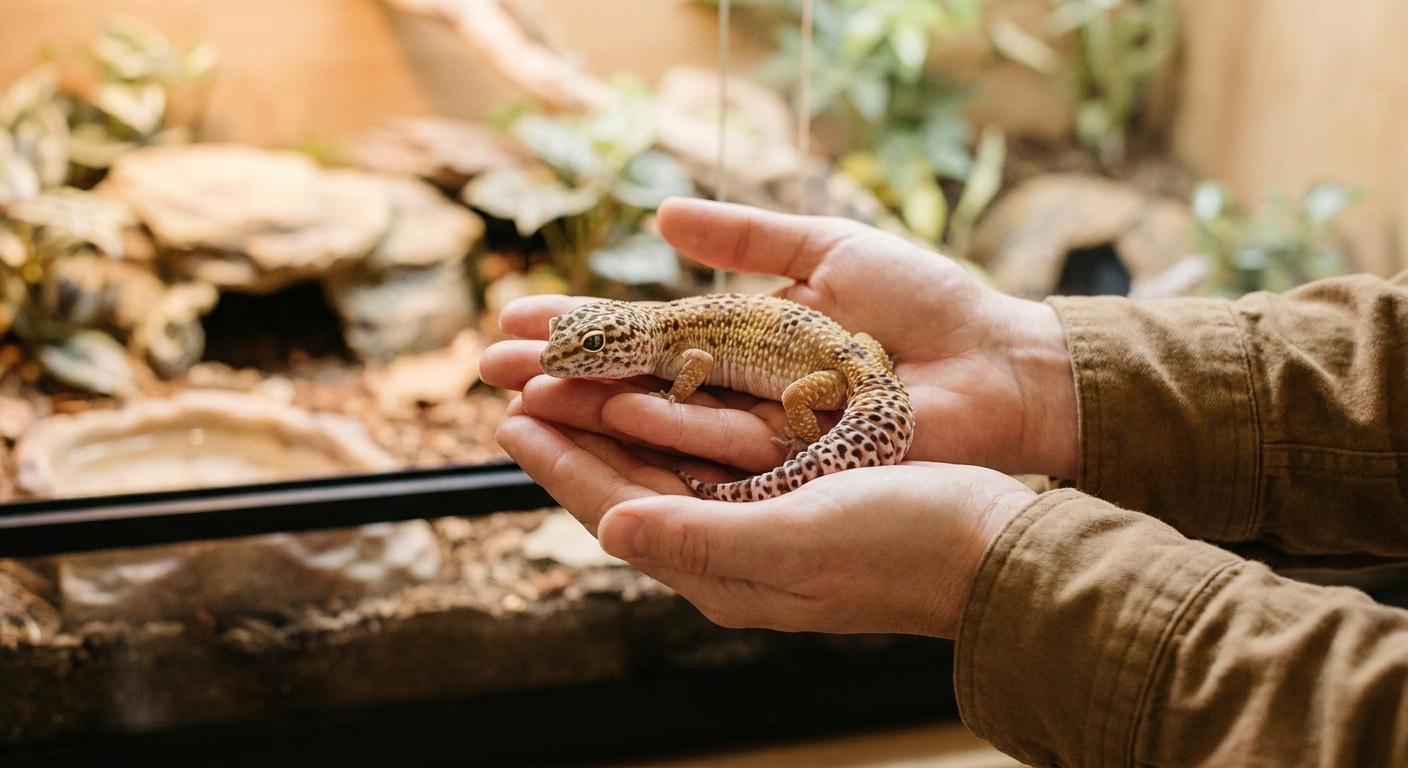
Leopard geckos tolerate being held rather than actively enjoy it. They do not experience affection or seek cuddles the way mammals do, but they can learn to associate you with safety and food, and a well-socialized gecko will rest calmly on your hand without stress. That distinction matters, because handling done on the gecko's terms builds trust, while handling done on yours builds fear.
infoQuick Answer
No, leopard geckos do not crave being held, but most learn to tolerate it comfortably. Reptiles lack the social bonding instincts of dogs and cats, so your gecko is not lonely between sessions. With patient taming, short sessions of 10-15 minutes, and 2-3 sessions per week, most leopard geckos become relaxed, confident handling companions within a few months.
The Complete Answer
Leopard geckos are solitary, crepuscular lizards from the rocky scrublands of Afghanistan, Pakistan, northwest India, and Iran. Nothing in their evolutionary history involves social touch. Wild geckos do not groom each other, huddle for comfort, or form pair bonds, so the brain circuitry that makes a dog lean into petting simply is not there.
What leopard geckos do have is a strong ability to learn from experience. A gecko that is handled gently and predictably learns that your hand is warm, stable, and never followed by anything bad. Over weeks, its stress response to you fades. Many geckos will eventually walk onto an offered hand voluntarily, and some choose to sit on their keeper for the warmth. That is genuine comfort, even if it is not affection in the mammal sense.
So the honest framing is this: your gecko will probably never like being held the way you like holding it. But it can reach a state where handling costs it nothing, and where you are a familiar, safe part of its world. For a reptile, that is the realistic best case, and it is a rewarding one.
What Handling Feels Like for a Leopard Gecko
To understand your gecko's perspective, remember its scale. An adult leopard gecko is 8-10 inches long and weighs 45-65 grams, so a human hand is enormous. Anything descending from above reads as a predator, which is why geckos should be scooped from the side with a flat palm, never grabbed over the back.
An untamed gecko experiences handling as capture: elevated heart rate, freeze-or-flee decisions, and sometimes defensive chirping. A tamed gecko experiences the same event very differently. Your hand is warm, roughly matching the 88-92°F (31-33°C) warm side it seeks out anyway, the surface is stable, and past experience says nothing bad happens here. The difference between those two experiences is entirely built by how you handle the taming process.
Signs Your Leopard Gecko Is Comfortable Being Held
- check_circleWalks onto your hand voluntarily instead of being lifted
- check_circleExplores your hands and arms with slow, deliberate movements
- check_circleRests or settles on your palm rather than constantly trying to leave
- check_circleFlicks its tongue calmly to investigate your skin
- check_circleKeeps a relaxed body posture with no tail waving or rapid breathing
- check_circleEats normally after sessions, since a stressed gecko often refuses food
Common Handling Mistakes
- check_circleGrabbing from above, which triggers an instinctive predator response
- check_circleHolding or restraining the tail, which the gecko can drop as a defense and takes months to regrow
- check_circleHandling a new gecko before it has had about two weeks to settle in
- check_circleHandling during shedding, when skin is sensitive and vision is reduced
- check_circleSessions that run too long, which push a tolerant gecko into stress
- check_circleSqueezing or restraining a gecko that wants to move, instead of letting it walk hand over hand
- check_circleHandling right after feeding, which can cause a gecko to regurgitate its meal
lightbulbKeep Sessions Short
Cap handling sessions at 10-15 minutes and aim for 2-3 sessions per week rather than daily marathons. Leopard geckos cannot regulate their body temperature away from their heat source, so long sessions cool them down and add stress. Short, positive, predictable sessions build trust faster than long ones.
Frequently Asked Questions
Do leopard geckos like their owners?expand_more
Can I cuddle my leopard gecko?expand_more
How often should I hold my leopard gecko?expand_more
Do leopard geckos get lonely?expand_more
Why does my leopard gecko run away when I try to hold it?expand_more
Bottom Line
Do leopard geckos like to be held? Not instinctively, and they never will in the way a dog likes contact. But they tolerate handling remarkably well for a reptile, and with patient taming most become calm, confident companions that treat your hand as safe ground. Keep sessions short, approach from the side, and let the gecko set the pace. For the step-by-step process, see our full guide on how to handle a leopard gecko.